When I first heard the word blockchain, I thought it was something very complicated and only useful for cryptocurrency. The name itself sounds technical, and many people explain blockchain using difficult words that can make beginners confused. But when I started learning about it, I realized that the basic idea is actually quite simple.
In my opinion, blockchain is simply a new way of storing and sharing information. Instead of keeping important information in one central place, blockchain allows information to be stored across a network of computers. The information is recorded in a way that makes it difficult to change or delete without everyone noticing.
Blockchain technology is now used in cryptocurrency, digital payments, business, supply chains, gaming, and many other areas. In this article, I will explain what blockchain technology means in simple words, how it works, why it is important, and where we can see it in everyday life.
What Is Blockchain
In simple words, a blockchain is a digital record book. Imagine a normal notebook where you write down transactions, such as who paid money to whom. A blockchain does something similar, but instead of one person keeping the notebook, many computers on a network keep copies of the same record.
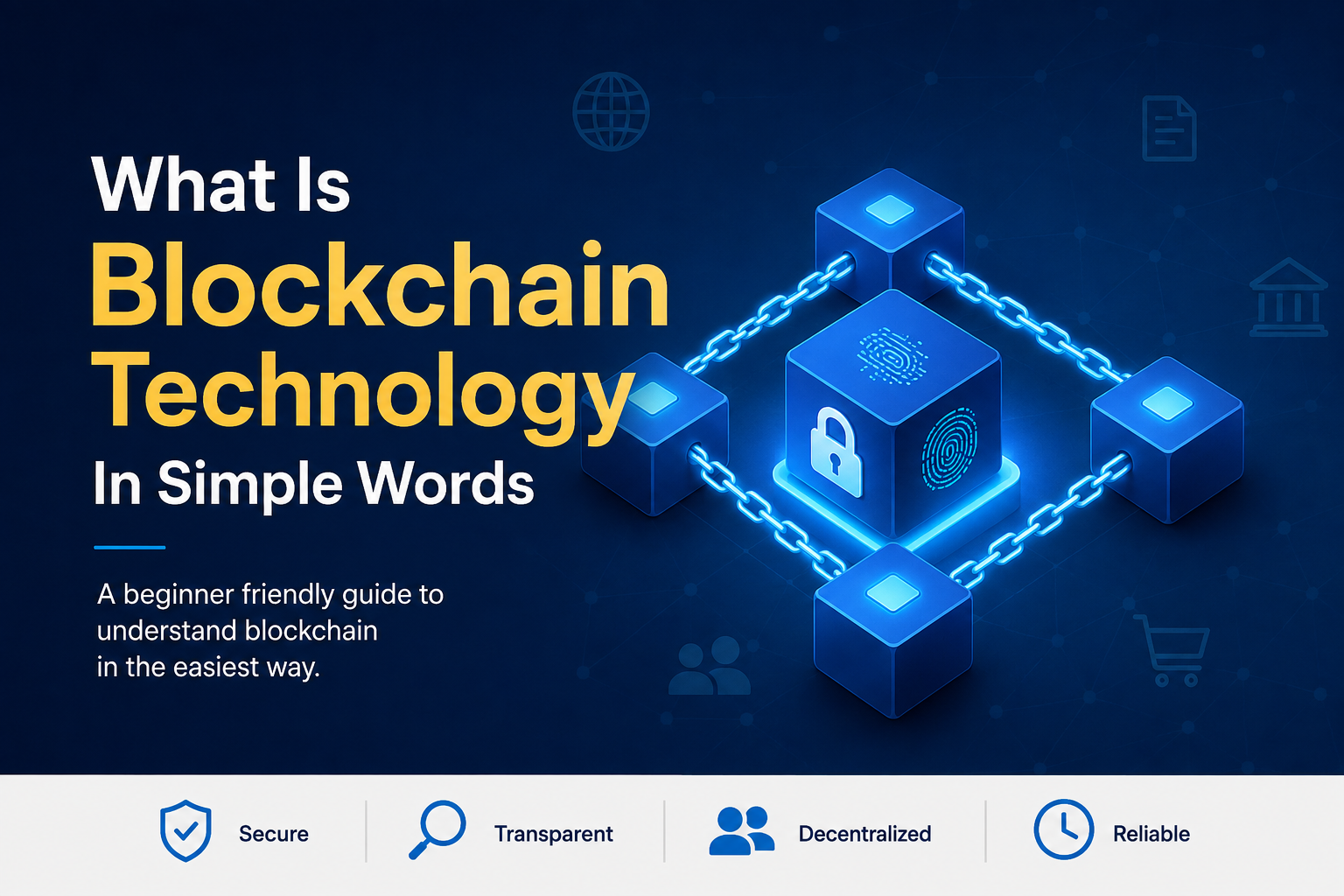
The word blockchain comes from two simple ideas: blocks and chains.
A block is a group of information. This information can include transactions or other types of digital records. When a block is completed, it is connected to the previous block. Then another block can be added after it. This creates a long chain of information.
That is why we call it a blockchain.
What I find interesting about this system is that the information is not controlled by only one person or one company. Instead, the network works together to maintain the record.
How Does Blockchain Work
The basic process is easier than it may sound.
Suppose I want to send cryptocurrency to another person. I create a transaction using my digital wallet. The transaction is then sent to the blockchain network.
Computers on the network check the transaction to make sure it follows the rules. They verify things such as whether I actually have enough funds to make the transaction.
Once the transaction is verified, it can be included with other transactions in a block. The network then confirms that block and adds it to the existing blockchain.
After the block has been added, the transaction becomes part of the permanent record.
The exact process can be different depending on the blockchain. Some networks use one method to confirm transactions while others use another method. But the main idea remains the same. Transactions are checked, recorded, and connected together in a shared digital record.
Why Is Blockchain Different
The biggest difference between blockchain and a traditional database is how information is controlled.
In a traditional system, a company usually has a central database. For example, a bank has its own database containing information about customer accounts and transactions. The bank controls that database and decides how the information is managed.
Blockchain can work differently because information can be distributed across many computers.
This does not mean that blockchain has no rules or organization. It simply means that the network does not always depend on one central authority to maintain the record.
For me, this is one of the most important ideas behind blockchain technology. It creates a system where multiple participants can agree on the same information without necessarily trusting one central organization.
What Is a Block
A block is basically a container for digital information.
In the case of cryptocurrency, a block can contain many transactions. It can also contain information that connects it to the previous block.
Each block has a unique digital identifier. This identifier is created using information from the block. If someone tries to change important information inside the block, its identifier can change.
The blockchain also connects each block to the previous one. Because of this connection, changing old information can become extremely difficult.
This is one reason blockchain is considered difficult to tamper with.
However, I think it is important to understand that difficult to change does not mean absolutely impossible in every situation. Different blockchain networks have different designs, security models, and levels of decentralization.
What Makes Blockchain Secure
Blockchain security comes from several different technologies and processes working together.
One important part is cryptography. Cryptography is used to protect information and verify transactions.
Another important part is the network itself. On many blockchains, thousands of computers may participate in maintaining the system. These computers communicate with each other and follow a set of rules.
If one computer has incorrect information, the rest of the network can help identify the correct version.
Blockchain networks also use systems called consensus mechanisms. These systems help computers agree on which transactions are valid and what information should be added to the blockchain.
Different blockchains use different consensus methods. Bitcoin, for example, uses a system called Proof of Work, while Ethereum currently uses Proof of Stake.
The technical details can be complicated, but the simple idea is easy to understand. The network needs a reliable way for participants to agree about the information being recorded.
Blockchain and Cryptocurrency
When most people hear about blockchain, they immediately think about Bitcoin. This makes sense because Bitcoin was one of the first major examples of blockchain technology.
Bitcoin uses blockchain to record transactions. Instead of a central bank keeping one private record of every Bitcoin transaction, the Bitcoin blockchain provides a public record that can be checked by participants.
Other cryptocurrencies also use blockchain technology, although their systems can work differently.
In my opinion, cryptocurrency is only one part of the blockchain story. Blockchain technology has possibilities beyond digital money.
This is important because many beginners believe blockchain and cryptocurrency are exactly the same thing. They are not.
Cryptocurrency is one use of blockchain technology. Blockchain is the underlying technology that can be used for many different purposes.
Blockchain Without Cryptocurrency
Blockchain can also be used for applications that do not involve cryptocurrency.
For example, companies can use blockchain to track products as they move through a supply chain. Imagine a product starting at a factory and moving through several warehouses before reaching a customer. Blockchain could be used to record important events during that journey.
Another possible use is digital identity. Blockchain systems can potentially help people manage and verify certain types of digital information.
Blockchain can also be used for digital ownership, records, certificates, and other applications.
However, I would not say that blockchain is automatically the best solution for every problem. Traditional databases can be faster, cheaper, and easier for many situations. Blockchain is most useful when there is a real reason to have a shared and verifiable record.
What Is Decentralization
Decentralization is another important concept in blockchain technology.
In a centralized system, one main organization controls the system. A bank is a simple example. The bank manages accounts, processes transactions, and maintains its records.
In a decentralized blockchain network, control can be distributed among many participants.
I think decentralization is one of the main reasons blockchain became so popular. It gives people a different way to think about trust and ownership.
Instead of saying that one company must always be trusted to maintain the record, blockchain technology can allow a network to verify and maintain that record according to predefined rules.
Still, not every blockchain is equally decentralized. Some networks have more participants and independent validators than others. So it is important to look at each project separately.
Benefits of Blockchain Technology
Blockchain has several potential advantages.
The first is transparency. On many public blockchains, people can inspect transaction records and verify what happened.
The second is security. Cryptography and network based verification can make unauthorized changes difficult.
The third is traceability. Blockchain can create a clear history of records, which can be useful when tracking products or transactions.
Another advantage is that blockchain can reduce the need for certain intermediaries in some situations.
It can also operate across borders because digital blockchain networks are not necessarily limited to one country.
These advantages are interesting, but they do not mean blockchain is perfect.
Problems With Blockchain
Like every technology, blockchain has disadvantages.
Some blockchain networks can process transactions more slowly than traditional payment systems. Network fees can also become expensive when many people are using the same blockchain.
Another issue is energy consumption. Certain blockchain systems, especially those using Proof of Work, can require significant amounts of computing power.
There are also security risks at the application level. While the blockchain itself may be difficult to change, cryptocurrency wallets, exchanges, and smart contracts can still have vulnerabilities.
Another problem is that blockchain technology can be difficult for beginners to understand. Private keys, wallets, transaction fees, smart contracts, and network confirmations can all feel confusing at first.
In my view, education is one of the biggest things needed for blockchain adoption. People need to understand how the technology works before they can use it safely.
The Future of Blockchain
I believe blockchain technology still has a lot of room to develop.
We are already seeing blockchain being used in finance, digital assets, gaming, supply chains, and other industries. At the same time, developers are working on making blockchain networks faster, more affordable, and easier to use.
I do not think blockchain will replace every existing database or financial system. That would not make much sense. Instead, I think blockchain will become another important technology that businesses and individuals can use when its specific advantages are useful.
The future may also bring better connections between blockchain systems and traditional financial services.
As the technology becomes easier to understand, more people may start using blockchain without even realizing they are interacting with it.
Final Thoughts
To me, blockchain technology is best understood as a shared digital record that allows information to be stored and verified across a network.
The technology may sound complicated because it involves cryptography, computer networks, consensus systems, and digital signatures. But the basic concept is quite simple.
A blockchain records information in blocks, connects those blocks together, and uses a network of computers to help verify the information.
Cryptocurrency is one of the most famous uses of blockchain, but it is not the only one. Blockchain can also be used for tracking products, managing digital assets, verifying records, and building new types of digital services.
I believe the most important thing for beginners is not to get lost in complicated technical terms. Start with the basic idea and then slowly learn how each part works.
Once you understand blockchain as a shared digital record, many other concepts become much easier to understand. Cryptocurrency, wallets, transactions, smart contracts, and digital assets all start making more sense.
For me, blockchain is not simply a technology connected to Bitcoin. It represents a different way of storing information, verifying transactions, and creating trust between people and organizations. That is what makes blockchain technology interesting and worth learning about.