When I first learned about cryptocurrency, one of the things that looked confusing to me was the crypto wallet address. At first glance, a wallet address can look like a random collection of letters and numbers. It does not look like a normal bank account number, email address, or phone number. However, once I understood how wallet addresses work, I realized that reading them is not as difficult as it seems.
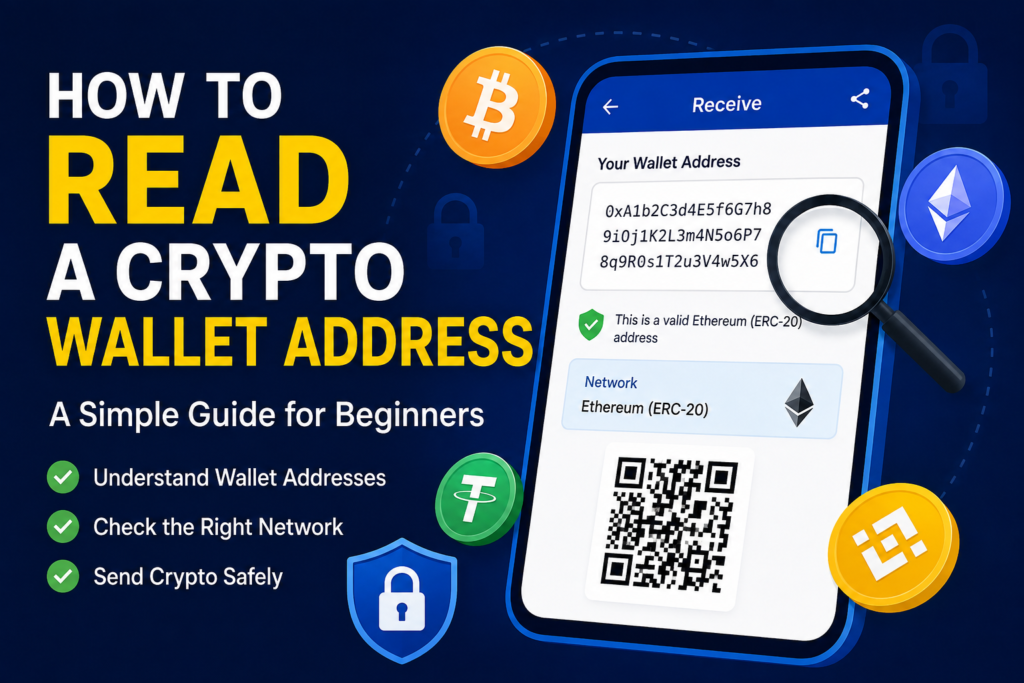
A crypto wallet address is basically a unique destination where cryptocurrency can be sent. Just like I need a bank account number to receive money through a bank, I need a wallet address to receive cryptocurrency. The important thing is that I have to use the correct address and the correct blockchain network when sending crypto.
In this article, I will explain how I read a crypto wallet address, what the different parts mean, what I check before sending cryptocurrency, and why even a small mistake can cause a serious problem.
What Is a Crypto Wallet Address?
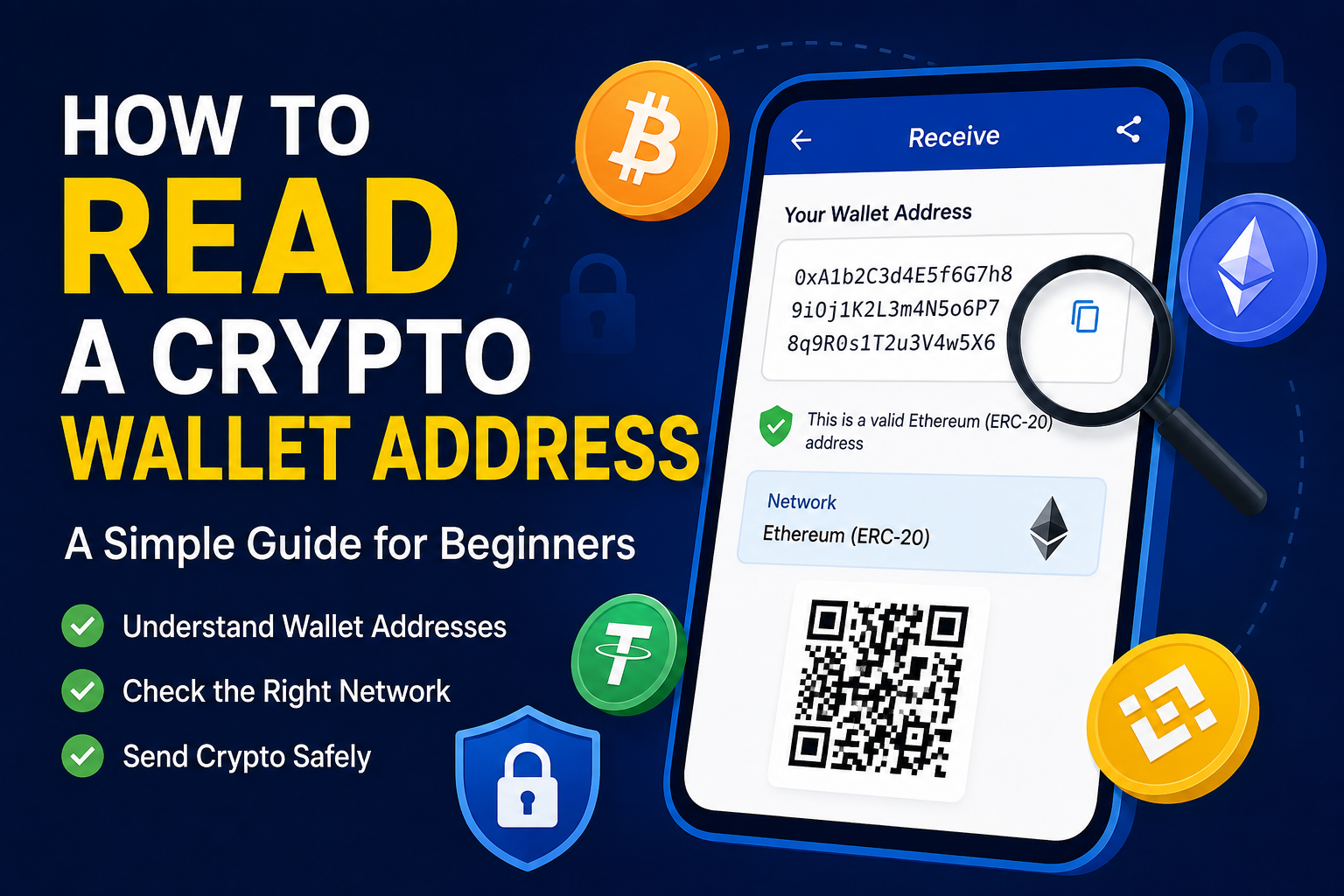
A crypto wallet address is a unique string of characters connected to a cryptocurrency wallet. It allows other people, exchanges, and applications to send cryptocurrency to my wallet.
The appearance of the address depends on the cryptocurrency and blockchain being used. For example, a Bitcoin address may look different from an Ethereum address. This is because different blockchains use different address formats.
An Ethereum address usually starts with 0x and is followed by a long combination of letters and numbers. A Bitcoin address can start with 1, 3, or bc1 depending on the address format.
When I look at a wallet address, I do not need to understand every single character individually. The main thing is to identify the blockchain, recognize the address format, and make sure the complete address matches the destination I want to use.
Understanding the Structure of an Address
The first thing I look at is the beginning of the address. The first few characters can give me a useful clue about the type of address I am dealing with.
For example, many Ethereum addresses start with 0x. If someone gives me an Ethereum address and it does not start with 0x, I would stop and check it before sending anything.
Bitcoin addresses can have different beginnings. Some older Bitcoin addresses start with 1, while other formats can start with 3 or bc1.
This does not mean that I can identify every wallet simply by looking at the first character. It is only one part of the checking process.
I also look at the length and general format of the address. A valid address usually has a specific structure depending on the blockchain. If something looks unusually short, contains strange symbols, or does not match the expected format, I do not use it until I confirm it.
Why Wallet Addresses Look Random
One question I had when I started learning about crypto was why wallet addresses look so complicated.
The simple answer is security and uniqueness. A blockchain needs a way to identify different destinations without relying on normal names or personal information.
Instead of using something like my name or phone number, a blockchain uses a long string of characters. This makes addresses difficult to guess and allows a huge number of unique wallet addresses to exist.
I think of a crypto wallet address like a digital destination. It does not need to tell me who owns it just by looking at it. Its purpose is to identify where the cryptocurrency should go.
Public Address and Private Key Are Different
This is one of the most important things I learned about crypto wallets.
A wallet address is normally safe to share when I want someone to send cryptocurrency to me. A private key is completely different.
The wallet address works like a receiving address. The private key is used to prove ownership and authorize transactions. I should never share my private key with another person.
In many wallets, I may also have a recovery phrase. This phrase is extremely sensitive because someone who gets access to it may be able to control the funds in the wallet.
So when I am reading a crypto wallet address, I make sure I am dealing with the public receiving address and not accidentally sharing sensitive wallet information.
Checking the Blockchain Network
One of the biggest mistakes a beginner can make is focusing only on the wallet address and ignoring the network.
The same cryptocurrency can sometimes exist on different networks. For example, a token may be available on Ethereum, BNB Smart Chain, or another compatible network.
This is where I pay extra attention. An address can look correct while the selected network is wrong.
Before sending crypto, I check both the wallet address and the network. I also check whether the receiving wallet or exchange supports that particular network.
I never assume that because two addresses look similar, they can automatically be used with the same network.
How I Check a Wallet Address Before Sending
Whenever I need to send cryptocurrency, I follow a simple checking process.
First, I identify the cryptocurrency I am sending. If I am sending Bitcoin, I make sure I am using a Bitcoin receiving address. If I am sending Ethereum or an Ethereum based token, I check the relevant network and address.
Second, I copy the receiving address directly instead of typing it manually. Manually entering a long address creates a higher chance of making a mistake.
Third, I compare the copied address with the address shown by the receiver.
Fourth, I check the network.
Finally, I review the transaction details one more time before confirming the payment.
This may take only a few seconds, but those seconds can save me from making a very expensive mistake.
Why You Should Not Trust Only the First and Last Characters
Many wallets and exchanges shorten addresses when displaying them. Instead of showing the entire address, they may show something like the beginning and ending characters.
This is useful for convenience, but I do not rely only on those shortened details when sending a large amount.
For example, two addresses could have the same first few characters and the same last few characters while being completely different in the middle.
That is why I prefer copying the complete address and checking it carefully. When possible, I also verify the address directly with the person or platform receiving the funds.
Using QR Codes
Another easy way to read and use a crypto wallet address is through a QR code.
Many cryptocurrency wallets allow me to display my receiving address as a QR code. Someone sending me crypto can scan the code instead of manually typing the address.
I find QR codes useful because they reduce the need to type a long string of characters.
However, I still check the information displayed by my wallet before confirming the transaction. A QR code is only helpful if it contains the correct destination and network.
Checking an Address on a Blockchain Explorer
A blockchain explorer is another useful tool for understanding wallet addresses.
A blockchain explorer allows me to search for an address and see publicly available blockchain information connected to it. Depending on the blockchain, I may be able to see the balance, transaction history, and previous transfers.
For example, if I have a Bitcoin address, I can search for it using a Bitcoin blockchain explorer. If I have an Ethereum address, I can use an Ethereum blockchain explorer.
This does not mean I can see someone’s private information. Blockchain transactions are generally public, but the identity behind an address may not be obvious from the address itself.
When I use an explorer, I make sure I am searching the correct blockchain. Looking up an address on the wrong network can create confusion.
Can I Find the Owner From the Address?
Usually, a crypto wallet address does not directly tell me the real name of the owner.
This is one reason cryptocurrency is often described as pseudonymous rather than completely anonymous. The transactions and addresses can be visible on a public blockchain, but the person’s identity is not necessarily displayed.
Sometimes an address can become connected to a person or organization through an exchange, business, public announcement, or other information. But simply looking at a random wallet address does not normally tell me who owns it.
Common Mistakes Beginners Make
There are several mistakes I try to avoid when dealing with wallet addresses.
The first mistake is sending cryptocurrency to the wrong address. A blockchain transaction may not be reversible, so I take the address seriously.
The second mistake is choosing the wrong network. This can be just as important as checking the address itself.
The third mistake is typing the address manually. I prefer copying and pasting whenever possible.
The fourth mistake is trusting an address sent through an unknown or suspicious message. Scammers can try to convince people to send money to their wallet.
Another mistake is sharing a private key or recovery phrase while thinking it is the same as a wallet address. It is not.
My Simple Rule for Reading Crypto Addresses
My approach is simple. I do not try to memorize every type of crypto address. Instead, I identify the cryptocurrency, check the address format, confirm the network, copy the complete address, and verify everything before sending.
For larger transactions, I would also consider sending a small test amount first if the situation allows it. Once I confirm that the funds arrived at the correct destination, I can consider sending the remaining amount.
This approach gives me much more confidence because I am not depending on just one check.
Final Thoughts
Learning how to read a crypto wallet address may seem complicated in the beginning, but it becomes much easier with practice. I now look at a wallet address as a digital destination rather than a meaningless combination of random characters.
The most important thing is not to rush. I check the cryptocurrency, address, network, and transaction details before confirming a payment. I also remember that a public wallet address can be shared for receiving funds, while private keys and recovery phrases should remain completely private.
Cryptocurrency gives me a lot of control over my money, but that control also means I have to be careful. A bank may sometimes be able to help with a mistaken transfer, but blockchain transactions can be difficult or impossible to reverse.
For me, the best habit is simple: check the address, check the network, and check it again before sending. A few extra seconds of attention can make a huge difference when dealing with cryptocurrency.