Bitcoin is one of the most talked about forms of digital money in the world. When I first started learning about Bitcoin, I found the idea a little confusing because it does not look like normal money. There are no physical Bitcoin notes or coins that I can keep in my wallet. Instead, Bitcoin exists digitally and uses technology to record and verify transactions.
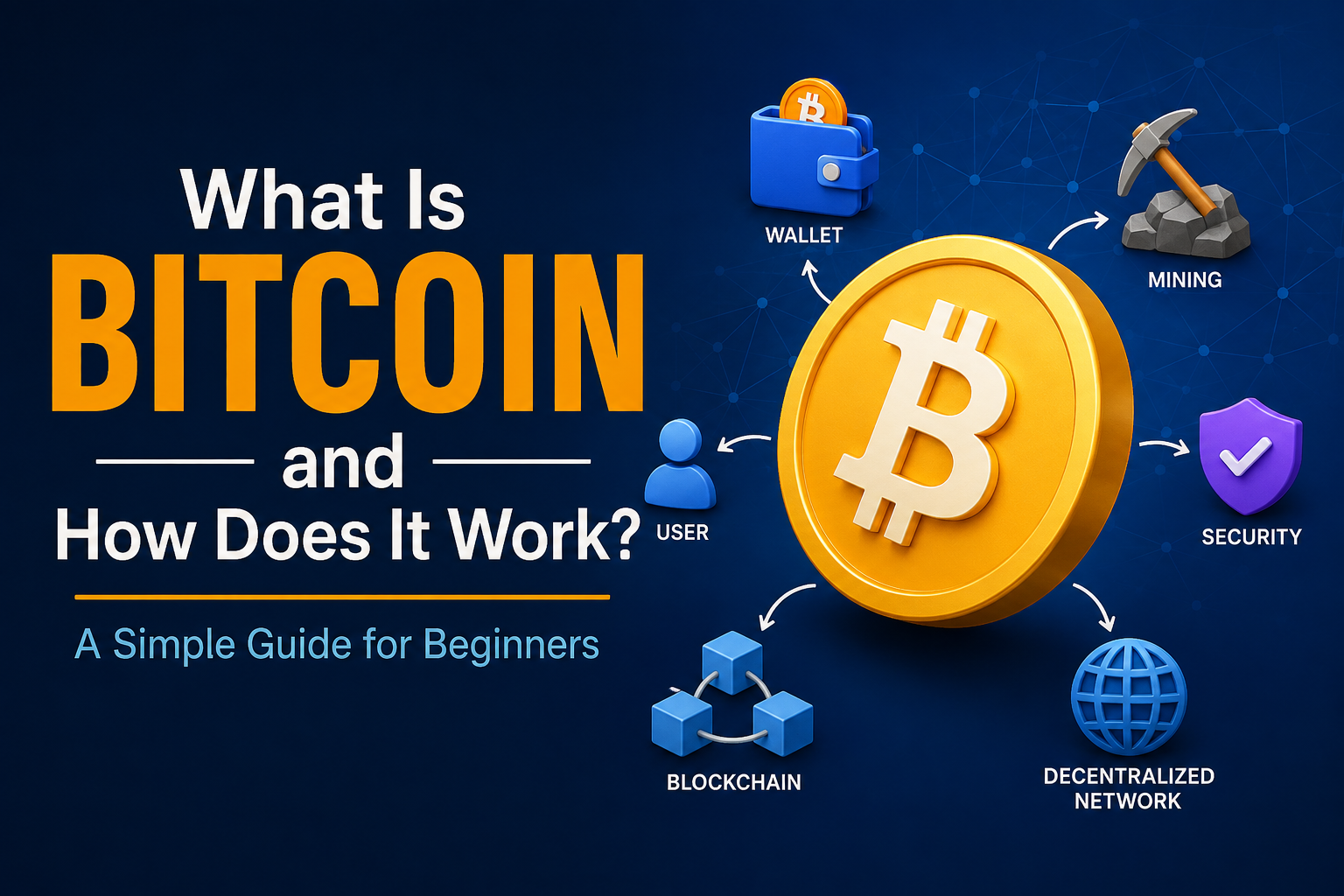
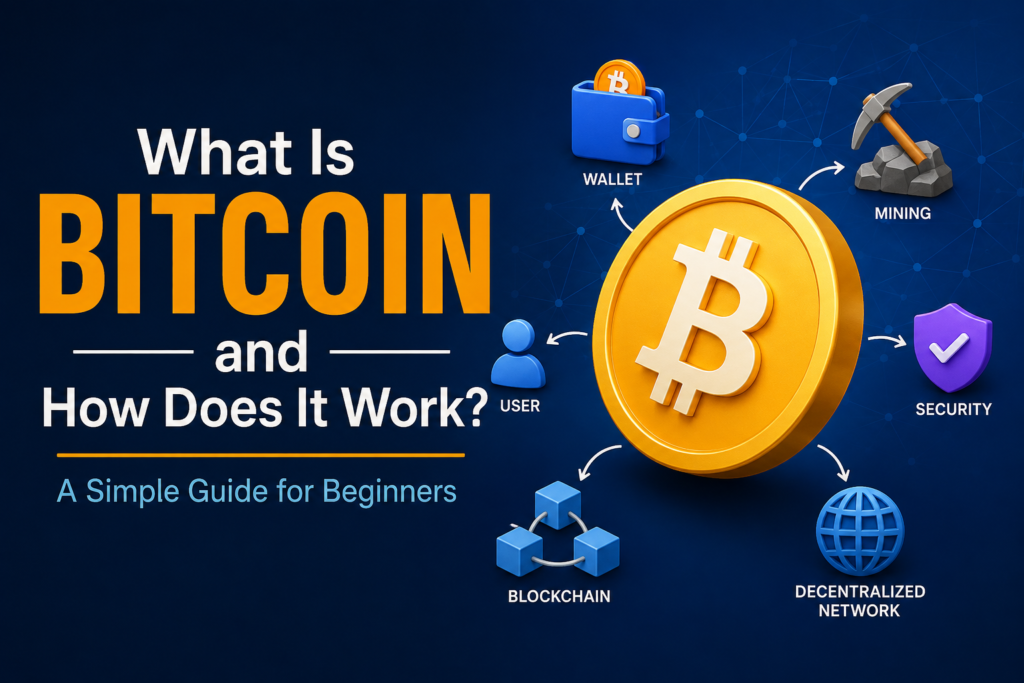
In my opinion, the easiest way to understand Bitcoin is to think of it as digital money that can be sent directly from one person to another without depending on a traditional bank. Behind this simple idea, however, there is a large network of computers, special software, cryptography, and a public record called the blockchain.
In this article, I will explain what Bitcoin is, how it works, how transactions are processed, what Bitcoin mining means, and why people are interested in using it.
What Is Bitcoin?
Bitcoin is a decentralized digital currency introduced in 2009 by a person or group using the name Satoshi Nakamoto. Unlike traditional currencies such as the US dollar or euro, Bitcoin is not controlled by a central bank or government.
Bitcoin was designed to allow people to transfer value over the internet without requiring a traditional financial institution to process every transaction.
I think this is one of the most important things to understand about Bitcoin. With a normal bank transfer, the bank keeps records of your money and verifies the transaction. With Bitcoin, these records are maintained across a large network of computers.
Bitcoin has a limited supply. The maximum number of Bitcoin that can ever exist is 21 million. This limited supply is one reason many people consider Bitcoin a scarce digital asset.
How Does Bitcoin Work?
Bitcoin works through a combination of blockchain technology, cryptography, computer networks, and a system called proof of work.
When someone sends Bitcoin, the transaction is broadcast to the Bitcoin network. Computers on the network check whether the transaction follows the rules. If everything is valid, the transaction can eventually be included in a block.
Blocks are connected together to form the blockchain. The blockchain acts like a public record of Bitcoin transactions.
What I find interesting is that no single company needs to maintain this record. Thousands of computers around the world participate in maintaining and checking the network.
This decentralized structure is a major difference between Bitcoin and traditional financial systems.
What Is the Bitcoin Blockchain?
The blockchain is basically a digital record of Bitcoin transactions.
Transactions are grouped into blocks. Each block contains information about transactions and is connected to the previous block. Because the blocks are connected, changing old information becomes extremely difficult.
When I think about the blockchain, I imagine a public accounting book that is copied across many computers. Everyone participating in the network follows the same basic rules, and the system is designed to make unauthorized changes extremely difficult.
The blockchain does not normally show people’s real names. Instead, transactions are associated with Bitcoin addresses and cryptographic information.
This gives Bitcoin a level of transparency because transactions can be viewed publicly while users can interact with the network using digital addresses.
What Is Bitcoin Mining?
Bitcoin mining is the process used to add new blocks of transactions to the blockchain and secure the network.
Miners use specialized computers to compete in solving a difficult mathematical problem. The process requires significant computing power and electricity.
When a miner successfully creates a valid block, the block can be added to the blockchain. The miner may receive a reward according to the Bitcoin network’s rules.
Mining also helps prevent someone from easily manipulating the transaction history.
In my view, mining is often misunderstood. It is not simply about creating new Bitcoin. It also plays an important role in confirming transactions and helping protect the network.
The amount of new Bitcoin created through mining is reduced over time through an event known as the Bitcoin halving. This process helps control the rate at which new Bitcoin enters circulation.
How Does a Bitcoin Transaction Work?
Sending Bitcoin may look simple from a user’s perspective, but several steps happen behind the scenes.
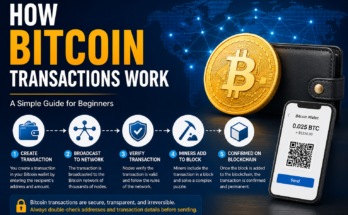
Suppose I want to send Bitcoin to another person. I would use a Bitcoin wallet to create a transaction. The transaction contains information about how much Bitcoin I want to send and where I want to send it.
The transaction is then digitally signed using my private key. This signature helps prove that I have the authority to spend the Bitcoin associated with my wallet.
The transaction is broadcast to the Bitcoin network. Network participants verify it according to Bitcoin’s rules.
Afterward, miners can include the transaction in a block. Once the block becomes part of the blockchain, the transaction receives confirmation.
Additional blocks added afterward can provide further confirmation.
What Is a Bitcoin Wallet?
A Bitcoin wallet is a tool that allows users to interact with their Bitcoin.
One important thing I learned is that a Bitcoin wallet does not literally store Bitcoin like a physical wallet stores cash. Bitcoin remains recorded on the blockchain.
Instead, the wallet manages the cryptographic keys that allow a person to access and control their Bitcoin.
There are different types of Bitcoin wallets. Some are software wallets that run on phones or computers. Others are hardware wallets designed to keep private keys more securely.
There are also wallets that allow users to manage their keys through different backup and security methods.
The most important thing to understand is that private keys are extremely important. If someone gets access to your private key or recovery information, they may be able to control your Bitcoin.
What Is a Bitcoin Address?
A Bitcoin address is a digital identifier that can be used to receive Bitcoin.
It is similar to giving someone your bank account details when you want them to send money, although Bitcoin addresses work differently from traditional bank accounts.
A person can generate multiple Bitcoin addresses. These addresses are created using cryptographic methods and are used by wallets when receiving funds.
It is generally important to check a Bitcoin address carefully before sending funds because Bitcoin transactions are generally irreversible.
Why Is Bitcoin Decentralized?
Bitcoin is decentralized because no single organization controls the entire network.
Instead, Bitcoin operates through a distributed network of computers called nodes. These computers communicate with one another and follow the rules of the Bitcoin protocol.
This means there is no central Bitcoin office that can simply decide which transactions are valid.
For me, this is one of the most interesting aspects of Bitcoin. The system is designed around rules and network participation rather than relying entirely on trust in one institution.
Decentralization can also make the network more resistant to certain types of centralized control or failure.
Why Does Bitcoin Have Value?
Bitcoin’s value comes from several factors, including scarcity, demand, network effects, usefulness, and people’s willingness to buy and hold it.
Bitcoin has a maximum supply of 21 million coins. This fixed supply is different from traditional currencies, where central banks can influence the money supply.
Some people view Bitcoin as a long term store of value. Others use it as a digital asset or a way to transfer money.
However, Bitcoin’s price can change dramatically. Its market value is influenced by supply and demand, investor sentiment, economic conditions, regulation, technological developments, and many other factors.
That is why I believe people should understand Bitcoin before thinking about buying it.
Is Bitcoin Anonymous?
Bitcoin is often described as anonymous, but I think it is more accurate to describe it as pseudonymous.
Bitcoin transactions are recorded publicly on the blockchain. The transaction itself does not normally display a person’s real name, but the activity connected to an address can potentially be analyzed.
If an address becomes connected to a real person’s identity, transactions associated with that address may become easier to associate with that person.
This is why users should not assume that Bitcoin transactions are completely private.
Advantages of Bitcoin
Bitcoin has several characteristics that make it attractive to users.
One major advantage is that it allows people to transfer value without relying directly on a traditional bank.
Bitcoin operates globally, so the network can be accessed from many parts of the world.
Another advantage is transparency. The blockchain provides a public record of transactions.
Bitcoin also has a predictable monetary supply schedule. The maximum supply is limited to 21 million Bitcoin.
At the same time, Bitcoin can be divided into very small units. The smallest commonly recognized unit is called a satoshi.
Risks of Bitcoin
Bitcoin also has risks, and I think these should never be ignored.
The first major risk is price volatility. Bitcoin’s price can rise or fall significantly over relatively short periods.
Another risk is security. If someone loses access to their private keys or recovery information, recovering the Bitcoin may be extremely difficult or impossible.
Scams are another concern. Because Bitcoin transactions are generally irreversible, sending Bitcoin to a scammer can result in a permanent loss.
There are also regulatory and tax considerations that can vary depending on where someone lives.
For these reasons, I would never recommend treating Bitcoin as guaranteed money or a risk free investment.
Bitcoin vs Traditional Money
Bitcoin and traditional money have some important differences.
Traditional money is generally issued and managed through governments and central banks. Banks and other financial institutions play important roles in processing and recording transactions.
Bitcoin operates through a decentralized network and uses blockchain technology.
Traditional money can exist as physical cash as well as digital balances. Bitcoin exists digitally.
Another major difference is supply. Governments and central banks can change the supply of national currencies according to monetary policy, while Bitcoin’s supply is governed by its protocol and limited to 21 million.
Neither system is perfect. Each has different advantages, limitations, risks, and purposes.
What Can Bitcoin Be Used For?
Bitcoin can be used for several purposes depending on the user and local regulations.
Some people use it to send money to other individuals. Others hold Bitcoin as a digital asset.
Some businesses have accepted Bitcoin as a payment method, although acceptance varies considerably.
Bitcoin can also be used to learn about blockchain technology, digital ownership, cryptography, and decentralized networks.
Personally, I think Bitcoin’s importance goes beyond simply being a digital currency. It introduced a practical example of how people can create a decentralized financial network using software and cryptographic principles.
Final Thoughts
Bitcoin is a decentralized digital currency that uses blockchain technology to record transactions and a distributed network to maintain the system.
The basic idea is not as complicated as it may seem at first. A user controls Bitcoin through cryptographic keys, transactions are broadcast to the network, network participants verify them, miners add valid transactions to blocks, and those blocks become part of the blockchain.
What makes Bitcoin especially interesting to me is that it combines money, computer networks, cryptography, and economics into one system.
At the same time, Bitcoin is not without risks. Its price can be highly volatile, transactions can be difficult to reverse, and protecting private keys is extremely important.
I believe the best way to approach Bitcoin is to learn how it works before thinking about buying or using it. Understanding the technology, the risks, and the basic principles can help anyone make more informed decisions about this unusual and influential form of digital money.