
When I first learned about Bitcoin, one of the things that confused me most was how a transaction could happen without a bank. With normal money, if I send money to someone, my bank checks my account, removes the amount, and sends it to the other person’s bank. Bitcoin works differently. There is no central bank controlling every transaction. Instead, a network of computers works together to verify and record transactions.
In my opinion, understanding Bitcoin transactions is one of the most important things for anyone who wants to understand Bitcoin properly. You do not need to be a programmer or a blockchain expert to understand it. Once the basic idea becomes clear, the whole process starts making much more sense.
What Is a Bitcoin Transaction?
A Bitcoin transaction is basically a digital record that says Bitcoin is being transferred from one person to another. For example, if I want to send 0.01 Bitcoin to a friend, I create a transaction that tells the Bitcoin network where the Bitcoin is coming from and where it should go.
However, Bitcoin does not work exactly like sending a file or sending money through a banking application. Bitcoin transactions are connected to previous transactions. The network checks whether the sender actually has enough Bitcoin available to spend.
A transaction usually contains information about the Bitcoin being spent, the destination address, the amount being transferred, and a digital signature that proves the transaction was authorized by the owner.
The important thing to understand is that Bitcoin itself is not stored inside your phone or computer like a normal digital file. The Bitcoin network keeps track of ownership through its blockchain.
Bitcoin Addresses
Before sending Bitcoin, the sender needs the recipient’s Bitcoin address. I like to think of a Bitcoin address as something similar to a bank account number, although the technology behind it is very different.
A Bitcoin address is a string of letters and numbers that tells the network where Bitcoin should be sent. Modern Bitcoin wallets can generate addresses automatically, and users usually do not need to understand how these addresses are mathematically created.
For example, when I want someone to send Bitcoin to me, I can provide my Bitcoin address. The other person can enter or scan that address in their wallet and choose the amount they want to send.
It is extremely important to check the address before confirming a transaction. Sending Bitcoin to the wrong address can be difficult or impossible to reverse.
What Is a Bitcoin Wallet?
A Bitcoin wallet is another important part of the transaction process. Many beginners think a wallet physically stores their Bitcoin. In reality, the wallet mainly manages the information needed to access and spend Bitcoin associated with addresses.
The most important information is the private key. A private key is a secret piece of information that allows someone to authorize transactions.
I think of a private key like a very powerful digital signature. If someone gets access to your private key, they may be able to spend your Bitcoin. That is why protecting private keys and recovery phrases is extremely important.
A wallet can create a transaction using the private key without showing that secret information to the Bitcoin network.
Creating a Bitcoin Transaction
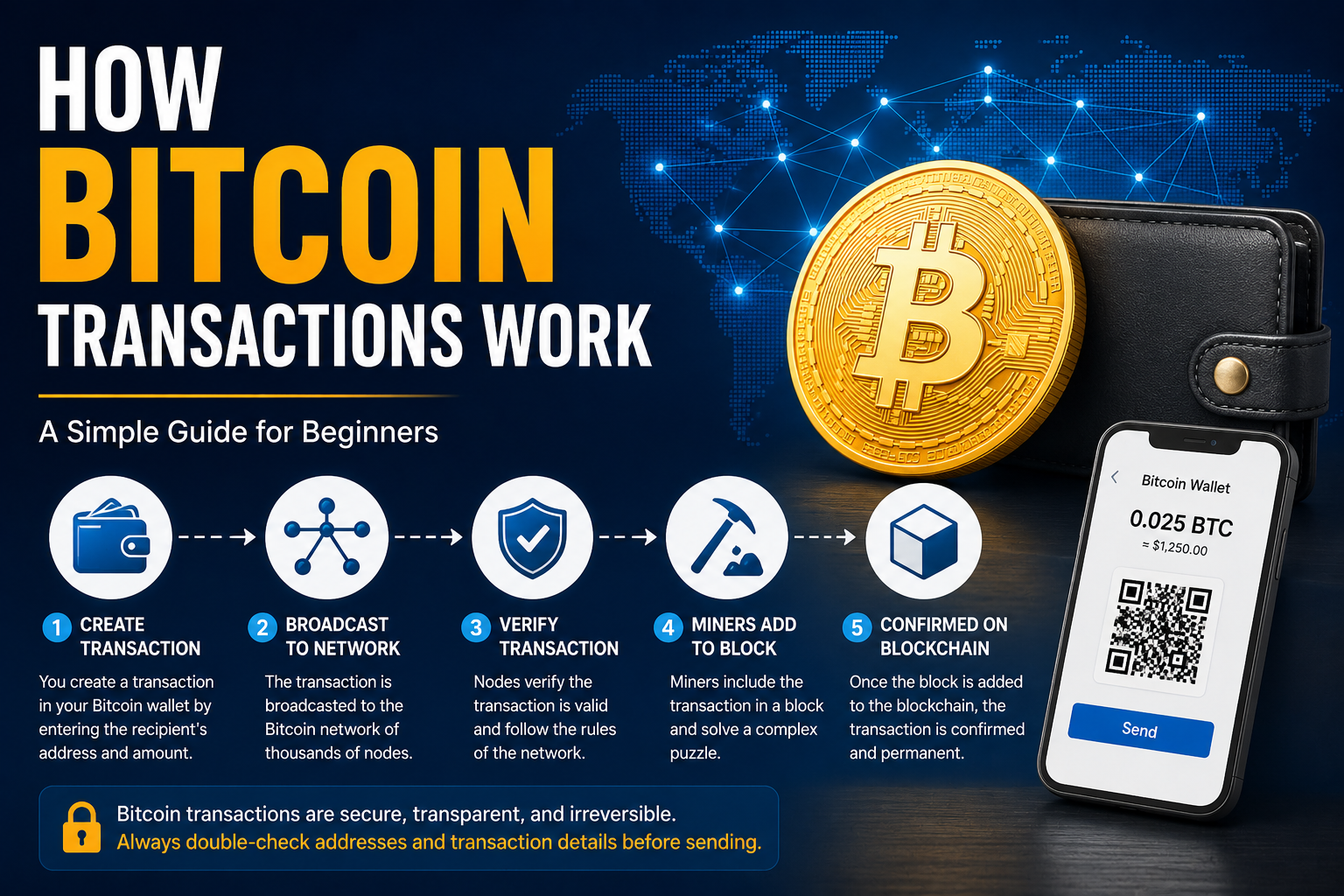
Suppose I want to send Bitcoin to another person. I would open my Bitcoin wallet, enter the recipient’s address, select the amount, and confirm the transaction.
Behind the simple wallet interface, several things happen.
The wallet checks the Bitcoin available to me and selects the appropriate transaction outputs that can be spent. It then creates a new transaction showing where the Bitcoin is coming from and where it should go.
The wallet also creates a digital signature using my private key. This signature provides proof that the transaction was authorized by the person controlling the Bitcoin.
The private key itself is not normally sent to the network. Instead, the transaction includes the digital signature that other participants can verify.
Digital Signatures
Digital signatures are one of the most important security features in Bitcoin.
When I send Bitcoin, the network needs to know that I have permission to spend it. Otherwise, anyone could simply claim someone else’s Bitcoin.
Bitcoin uses cryptographic methods to solve this problem. The sender signs the transaction with their private key. Other computers on the network can then use the corresponding public information to verify that the signature is valid.
This allows the network to confirm that the transaction was authorized without revealing the private key.
This is one reason Bitcoin can operate without a traditional bank. Instead of trusting one organization to approve every payment, the network uses cryptography and consensus rules to verify transactions.
Broadcasting the Transaction
After a transaction is created and signed, the wallet sends it to the Bitcoin network.
Bitcoin operates through a distributed network of computers called nodes. These nodes communicate with each other and share information about transactions.
When a transaction reaches the network, nodes check whether it follows Bitcoin’s rules. They verify things such as the digital signature and whether the Bitcoin being spent is actually available.
If the transaction appears valid, it can be passed from one node to another. Eventually, it becomes known across a large part of the Bitcoin network.
At this stage, the transaction may be considered unconfirmed.
What Does Unconfirmed Mean?
An unconfirmed Bitcoin transaction is a valid transaction that has been broadcast to the network but has not yet been included in a confirmed block.
This does not automatically mean something is wrong.
Transactions usually wait in an area commonly called the mempool before being included in a block. Different nodes can have slightly different views of their mempool.
When Bitcoin miners select transactions for a new block, they generally consider transaction fees and other factors when deciding which transactions to include.
This is why a Bitcoin transaction can sometimes confirm quickly while another transaction takes longer.
The Role of Bitcoin Miners
Bitcoin miners play an important role in confirming transactions and adding new blocks to the blockchain.
Miners collect valid transactions and organize them into blocks. They then compete to solve a computational puzzle as part of Bitcoin’s proof of work system.
The miner that successfully produces a valid block can broadcast it to the network. Other nodes verify the block and its transactions.
If everything follows the rules, the block can become part of the Bitcoin blockchain.
This process helps protect the network and makes it difficult for someone to rewrite transaction history.
What Is a Bitcoin Block?
A Bitcoin block is basically a collection of transactions that has been accepted into the blockchain.
Each block contains information that connects it to the previous block. This creates a chronological chain of blocks, which is why the technology is called a blockchain.
When my transaction is included in a block, it receives its first confirmation.
More blocks added after that block provide additional confirmations. In general, the more confirmations a transaction has, the more difficult it becomes to reverse through an attack on the network.
For smaller transactions, fewer confirmations may sometimes be considered acceptable. For larger transactions, businesses and services may wait for more confirmations.
Bitcoin Transaction Fees
Bitcoin transactions can include fees paid to miners.
These fees are not simply a fixed percentage of the amount being sent. Instead, fees are generally related to the amount of data a transaction occupies in a block.
When the network becomes busy, users may choose higher fees to encourage miners to include their transactions sooner.
When the network is less busy, fees may be lower.
I think this is an important point for beginners because sending a small amount of Bitcoin does not necessarily mean the transaction fee will always be small. The fee depends more on transaction characteristics and network conditions than simply the amount being transferred.
Bitcoin Uses Unspent Transaction Outputs
One technical concept that helps explain Bitcoin transactions is called the unspent transaction output, often shortened to UTXO.
Instead of maintaining a simple account balance like a traditional bank, Bitcoin keeps track of outputs from previous transactions that have not yet been spent.
For example, if I receive Bitcoin in one transaction, that received amount can become an available output that I later use in another transaction.
If I want to spend only part of it, the transaction can send some Bitcoin to another person and return the remaining amount to an address controlled by me. This remaining amount is commonly called change.
This system may sound complicated at first, but wallets handle most of the details automatically.
Why Bitcoin Transactions Are Difficult to Reverse
One major difference between Bitcoin and traditional payment systems is that Bitcoin transactions are generally designed to be irreversible once sufficiently confirmed.
If I accidentally send Bitcoin to the wrong address, there is no central Bitcoin company that I can call to cancel the transaction.
This is both a benefit and a responsibility.
The lack of a central authority means users have more direct control over their money. At the same time, users need to be careful when entering addresses, choosing amounts, and protecting their wallet information.
Is Bitcoin Transaction Information Public?
Yes, Bitcoin transactions are recorded on a public blockchain.
Anyone can inspect the blockchain and see transaction information such as the addresses involved and the amount transferred. However, Bitcoin addresses do not automatically reveal the real world identity of the person controlling them.
This is why Bitcoin is often described as pseudonymous rather than completely anonymous.
If an address becomes connected to someone’s real identity through an exchange, payment service, investigation, or another method, transactions associated with that address may become easier to associate with that person.
How Long Does a Bitcoin Transaction Take?
The time required for a Bitcoin transaction to receive confirmation can vary.
One major factor is the time between blocks. Bitcoin’s system targets an average block interval of around ten minutes, but individual blocks do not arrive at exactly ten minute intervals.
Network activity and transaction fees can also affect how quickly a transaction is included in a block.
Personally, I think beginners should avoid thinking of Bitcoin confirmation as an exact timer. A transaction can be visible on the network before it receives confirmation, and confirmation happens when it becomes part of an accepted block.
Final Thoughts
Understanding how Bitcoin transactions work makes Bitcoin much less mysterious. In simple terms, a user creates a transaction, the wallet signs it, the transaction is broadcast to the Bitcoin network, nodes verify it, miners include it in a block, and the blockchain records that block as part of Bitcoin’s transaction history.
What I find most interesting about Bitcoin is that this entire system works without one central organization controlling every payment. Instead, wallets, cryptography, nodes, miners, and consensus rules work together to maintain the network.
For beginners, the most important things to remember are to protect your private keys, carefully check Bitcoin addresses before sending funds, understand transaction fees, and remember that confirmed Bitcoin transactions are generally not reversible.
Once these basic ideas are clear, topics such as Bitcoin mining, blockchain technology, wallets, confirmations, and transaction fees become much easier to understand. Bitcoin may look complicated from the outside, but its basic transaction process can actually be understood by anyone who takes the time to learn it step by step.