When I first heard about cryptocurrency, I found the whole idea a little confusing. People were talking about Bitcoin, blockchain, digital wallets, mining, and private keys, but it was not immediately clear how all these things actually worked together. The more I learned about cryptocurrency, the more I realized that the basic idea is not as complicated as it sounds.
In simple words, cryptocurrency is a type of digital money that exists electronically. Unlike traditional money, it is usually not controlled by a central bank or government. Instead, cryptocurrency uses computer networks and special technology to record and verify transactions.
In this article, I will explain how cryptocurrency works from a beginner’s point of view. I will keep things simple so that someone who has never used cryptocurrency before can understand the basic process.
What Is Cryptocurrency?
Cryptocurrency is digital money that uses cryptography to protect transactions and control the creation of new units. The word cryptocurrency comes from two ideas: cryptography and currency.
Cryptography is a method of protecting information. In cryptocurrency, it helps keep transactions secure and makes it difficult for someone to change transaction records without permission.
The biggest difference between cryptocurrency and regular money is how the system is managed. When I use traditional money, banks and financial institutions usually help process and record my transactions. With cryptocurrency, transactions can be verified by a network of computers.
Bitcoin was the first major cryptocurrency. It was introduced in 2009 and created the foundation for many other cryptocurrencies that came later. Today, thousands of cryptocurrencies exist, although they are not all used for the same purpose.
What Is Blockchain?
To understand how cryptocurrency works, I believe the most important thing to understand is blockchain.
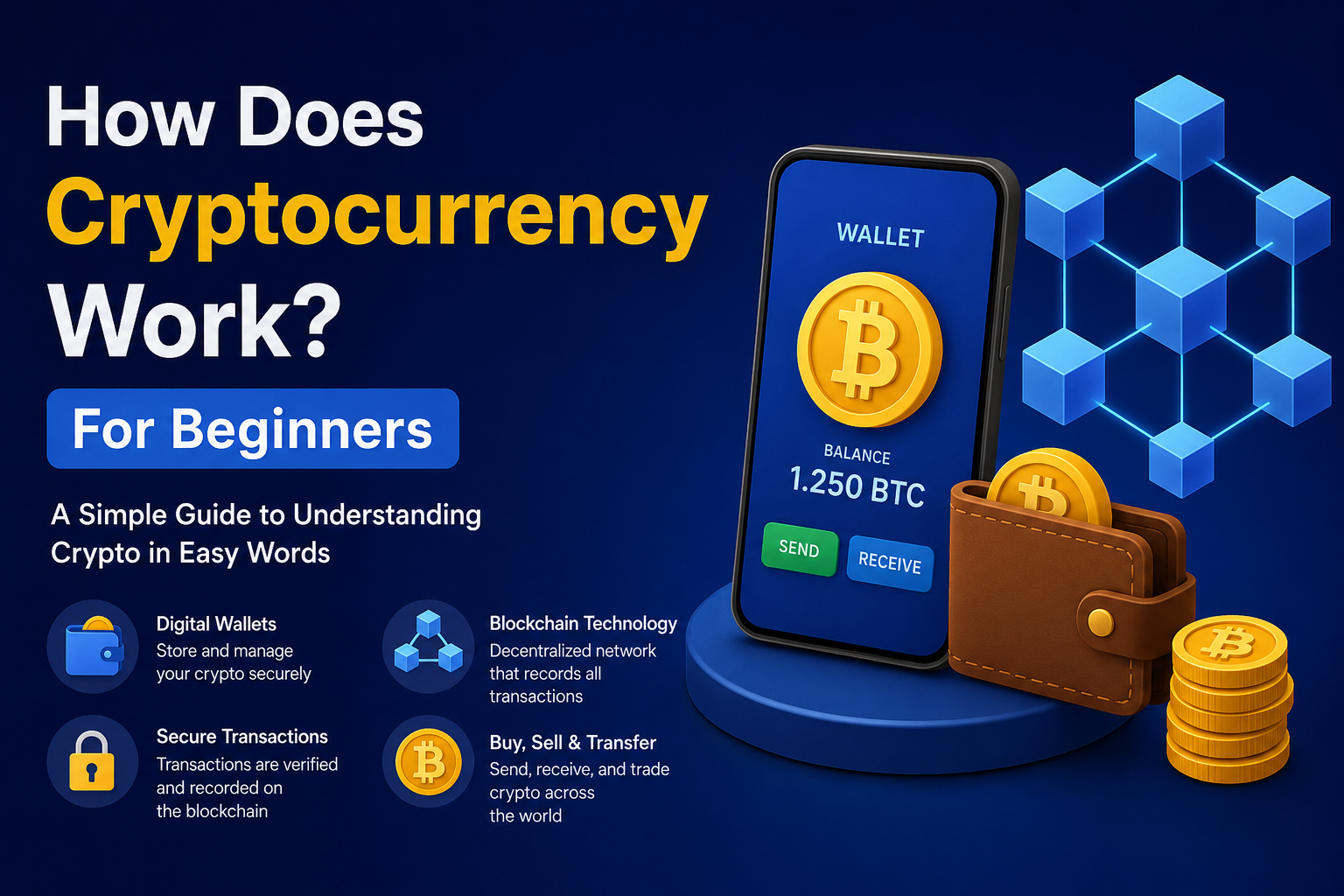
A blockchain is basically a digital record of transactions. You can think of it as a large public record book that keeps information about cryptocurrency transactions.
For example, imagine that I send some Bitcoin to another person. That transaction needs to be recorded. Instead of one bank keeping the record, the transaction can be added to a blockchain that is maintained by a network of computers.
Transactions are grouped together into blocks. These blocks are then connected to previous blocks, creating a chain. This is where the name blockchain comes from.
One important feature of a blockchain is that changing old information is extremely difficult. Once transactions have been properly recorded and confirmed, changing them would require significant control over the network.
This is one of the main reasons blockchain technology is considered useful for digital currencies.
How Does a Cryptocurrency Transaction Work?
Suppose I want to send cryptocurrency to someone. The process may look complicated in the background, but the basic idea is quite simple.
First, I open my cryptocurrency wallet and enter the recipient’s wallet address. Then I choose how much cryptocurrency I want to send.
The transaction is digitally signed using information connected to my wallet. This proves that the transaction was authorized by the person who controls the wallet.
The transaction is then sent to the cryptocurrency network. Computers on the network check whether the transaction follows the rules.
For example, the network needs to make sure that I actually have enough cryptocurrency to send. If everything is valid, the transaction can be included in a block and added to the blockchain.
After enough confirmation, the recipient can consider the transaction completed.
The exact process can be different depending on the cryptocurrency, but this is the basic idea.
What Is a Cryptocurrency Wallet?
A cryptocurrency wallet is another important part of the system.
Many beginners imagine a wallet as a digital version of a physical wallet where coins are stored. In reality, cryptocurrency wallets work differently.
Your cryptocurrency exists on the blockchain. The wallet mainly helps you access and manage your cryptocurrency by using cryptographic keys.
A wallet normally has a public address and private information.
The public address can be shared with other people when you want to receive cryptocurrency. It is similar to giving someone your bank account details for receiving money, although the systems are very different.
The private key is much more important. It allows you to control the cryptocurrency associated with your wallet. If someone gets access to your private key or recovery phrase, they may be able to control your funds.
That is why I think beginners should take wallet security very seriously.
What Is Cryptocurrency Mining?
When people hear the word cryptocurrency mining, they often imagine someone physically digging for digital coins. Of course, that is not what happens.
Mining is a process used by some cryptocurrency networks, such as Bitcoin, to help verify transactions and maintain the network.
Computers compete to solve complex mathematical problems. The computers involved use significant computing power to perform this work.
When a miner successfully completes the required process, they may receive a reward in cryptocurrency, depending on the rules of that particular network.
Mining also helps prevent certain types of fraud and keeps the transaction history organized.
However, not every cryptocurrency uses mining. Some cryptocurrencies use different systems to confirm transactions.
What Is Proof of Work?
Bitcoin uses a system called proof of work.
In simple terms, proof of work requires participants called miners to use computing power to solve a difficult mathematical problem. The first miner to successfully complete the required work can have their block accepted by the network if it follows all the rules.
This process makes attacking the network expensive because an attacker would need a huge amount of computing power.
Proof of work is one reason Bitcoin requires a lot of electricity. This has become an important topic in discussions about cryptocurrency and its environmental impact.
What Is Proof of Stake?
Another method used by some cryptocurrencies is called proof of stake.
Instead of relying mainly on powerful computers solving mathematical problems, proof of stake allows participants to help secure the network by locking or staking cryptocurrency.
These participants can be selected to help validate transactions and create new blocks. In return, they may receive rewards.
I find proof of stake interesting because it can require much less energy than traditional proof of work systems.
Different cryptocurrencies use different approaches, so it is always worth learning how a particular cryptocurrency actually operates before using it.
How Does Cryptocurrency Have Value?
This is one of the biggest questions beginners usually have.
Why does Bitcoin have value if it is not a physical coin?
The simple answer is that value depends on several factors, including demand, scarcity, usefulness, trust, and what people are willing to pay for it.
Bitcoin has a limited supply. Only a certain number of Bitcoin can ever exist. Many people believe that this limited supply contributes to its value.
Other cryptocurrencies may have different purposes. Some are designed to support applications, smart contracts, payments, or other digital services.
Just like other assets, cryptocurrency prices can change because of supply and demand. This means prices can rise quickly, but they can also fall quickly.
For this reason, I would never suggest that someone treat cryptocurrency as guaranteed money.
What Are Cryptocurrency Exchanges?
If I want to buy cryptocurrency, one common option is to use a cryptocurrency exchange.
An exchange is a platform where people can buy and sell digital assets. Depending on the platform and country, users may be able to purchase cryptocurrency using traditional currencies.
For example, a person might deposit money into an exchange and use it to buy Bitcoin or another cryptocurrency.
After purchasing cryptocurrency, the user can keep it on the exchange or transfer it to a personal wallet.
For beginners, it is important to understand that exchanges involve risks too. Account security, scams, hacking, and fraudulent platforms are all issues that users should take seriously.
Why Do People Use Cryptocurrency?
People use cryptocurrency for different reasons.
Some people see it as an alternative form of money. Others are interested in investing or trading. Some people use cryptocurrencies to access blockchain based applications.
Cryptocurrency can also make it possible to send money across borders without using the traditional banking system in the same way.
However, cryptocurrency is not perfect. Transactions can sometimes be expensive or slow depending on the network. Prices can also be extremely volatile.
In my opinion, understanding both the benefits and the risks is much more important than simply following cryptocurrency trends.

Is Cryptocurrency Safe?
Cryptocurrency technology can be very secure, but that does not mean every cryptocurrency experience is safe.
A blockchain can have strong security features, but users can still lose money through scams, stolen passwords, fake websites, hacked accounts, or poor investment decisions.
One of the biggest lessons I think beginners should remember is that you are responsible for protecting your account and wallet information.
Never share your private key or recovery phrase with someone who asks for it. Be careful with links, investment promises, and people who guarantee huge returns.
If something sounds too good to be true, I believe it is better to stop and investigate before sending any money.
Final Thoughts
Understanding how cryptocurrency works becomes much easier when you break it into smaller parts.
Cryptocurrency is digital money that uses cryptography and decentralized computer networks. Blockchain technology records transactions and helps maintain a shared history. Wallets allow users to manage access to their cryptocurrency. Networks use different methods, such as proof of work or proof of stake, to confirm transactions.
For me, the most important thing about learning cryptocurrency is not trying to understand everything in one day. Start with the basic concepts, learn how wallets and transactions work, understand the risks, and only then explore more advanced topics.
Cryptocurrency can be an interesting part of modern technology and finance, but it should be approached with knowledge and caution. The technology has many possibilities, but there are also serious risks.
If you are completely new to cryptocurrency, do not feel pressured to invest immediately. First understand what you are buying, how it works, where your money is going, and what could happen if the price changes.
Once you understand these basics, topics like Bitcoin, Ethereum, blockchain, crypto wallets, mining, staking, and decentralized applications become much easier to understand.
In my view, learning first and investing later is a much better approach than investing first and trying to understand cryptocurrency afterward.