When I first started learning about cryptocurrency, I found many terms confusing. One of the things that took me some time to understand was the difference between coins and tokens. At first, I thought both were basically the same thing because both could be used in crypto transactions and both had value. After learning more about how blockchain technology works, I realized that coins and tokens are actually different in some important ways.
In simple words, a coin is a cryptocurrency that operates on its own blockchain, while a token is usually created and operates on an existing blockchain. This sounds simple, but there is more to the difference than just that. Coins and tokens can have different purposes, uses, and ways of being created.
In this article, I will explain the difference between coins and tokens in a simple way. I will also share how I understand these two concepts and why knowing the difference can be useful for anyone who is interested in cryptocurrency.
What Is a Cryptocurrency Coin?
A cryptocurrency coin is a digital asset that has its own blockchain network. The blockchain is basically the technology that records transactions and keeps track of ownership. Because a coin has its own blockchain, it does not need another blockchain to operate.
Bitcoin is one of the easiest examples to understand. Bitcoin operates on the Bitcoin blockchain. Every Bitcoin transaction is recorded on that network. Bitcoin was designed mainly as a form of digital money that people can use to transfer value without relying on a traditional bank.
Ethereum is another example of a cryptocurrency coin. Ethereum has its own blockchain, known as the Ethereum network. Ether, usually called ETH, is the native cryptocurrency of this blockchain. It is used to pay transaction fees and support different activities on the network.
Other examples of coins include Litecoin, Dogecoin, and Solana. Each of these has its own blockchain network and its own native cryptocurrency.
From my point of view, the easiest way to remember a coin is to think of it as the main currency of its own blockchain. Just like a country can have its own currency, a blockchain network can have its own native coin.
What Is a Cryptocurrency Token?
A token is a little different. A token usually does not have its own independent blockchain. Instead, it is created and operates on an existing blockchain.
For example, many tokens are created on Ethereum. Ethereum provides the blockchain infrastructure, while different projects create their own tokens on top of it. These tokens can be designed for many different purposes.
Some tokens can represent digital assets, membership, voting rights, access to a service, or even ownership of something. Others are simply created as cryptocurrencies that people can buy, sell, or use within a particular project.
Stablecoins are a good example. USDC is a token that operates on blockchain networks such as Ethereum and several other supported networks. Its purpose is to maintain a value close to the US dollar.
Another example is Uniswap’s UNI token. It is connected to the Uniswap ecosystem and gives holders certain governance related abilities.
When I think about tokens, I see them as digital assets that use an existing blockchain instead of needing to build an entirely new blockchain from the beginning.
The Biggest Difference Between Coins and Tokens
The biggest difference is the blockchain they use.
A coin has its own blockchain. Bitcoin has the Bitcoin blockchain. Ether operates on Ethereum. Solana has its own blockchain and uses SOL as its native coin.
A token usually exists on another blockchain. For example, a token can be created using Ethereum’s infrastructure. The token depends on the underlying blockchain to process and record its transactions.
This difference is important because creating a new blockchain can be complicated. Developers have to build the network, maintain it, secure it, and encourage people to use it.
Creating a token can be much easier because developers can use an existing blockchain. Instead of building everything from the beginning, they can use smart contracts and established blockchain technology.
Coins Are Often Used for Payments
Coins are commonly designed to function as digital money or as the native currency of a blockchain network.
Bitcoin is probably the best example. People can send Bitcoin to each other without using a traditional payment system. The Bitcoin network processes and records these transactions.
Coins can also be used to pay blockchain transaction fees. For example, ETH is used to pay gas fees on Ethereum. Similarly, SOL is used to pay fees on the Solana network.
This is one reason coins are so important. Without the native coin, many blockchain networks would have difficulty operating because users need to pay transaction fees.
From my perspective, I think of coins as the fuel that helps their blockchain networks run.
Tokens Can Have Many Different Purposes
Tokens can be much more flexible than coins because developers can create them for specific purposes.
A token might be used to access a particular application. It might provide voting rights in a decentralized organization. It might represent an asset. It could also be used as a reward inside a platform.
Some tokens are created for decentralized finance applications. Others are connected to gaming projects, digital collectibles, communities, or other blockchain based services.
This flexibility is one of the reasons tokens became so popular. A project does not necessarily need to create a completely new blockchain just to create a digital asset.
For example, a developer can create a token on Ethereum using a token standard such as ERC 20. The token can then interact with wallets, exchanges, and other applications that support that standard.
How Coins and Tokens Are Created
Coins and tokens are also different when it comes to creation.
Creating a coin usually means creating or launching a blockchain network. This can require a lot of technical knowledge, infrastructure, security work, and community support.
Developers need to decide how transactions will be confirmed, how the network will be secured, and how new coins will be issued.
Creating a token can be easier because developers can use an existing blockchain. They can create a smart contract that defines how the token works.
For example, a project can create a token on Ethereum without creating a completely new blockchain. The Ethereum network handles the underlying transactions while the project’s smart contract manages the token rules.
I think this is one of the most interesting parts of cryptocurrency. A blockchain can provide the foundation while thousands of different tokens can be built on top of it.
Transaction Fees Are Another Difference
Coins are often directly connected to transaction fees on their own blockchain.
If I want to send ETH on the Ethereum network, I need ETH to pay the network fee. If I want to send SOL on Solana, SOL is used to pay the transaction fee.
Tokens can also require the native coin of the blockchain for transaction fees.
For example, if I hold a token that operates on Ethereum and want to send that token, I may need ETH to pay the Ethereum network fee. The token itself is not necessarily what pays the underlying blockchain fee.
This is something beginners sometimes overlook. A person may have tokens in a wallet but still be unable to move them if they do not have enough of the blockchain’s native coin to cover the transaction fee.
Coins and Tokens Can Both Have Value
Another important point is that both coins and tokens can have financial value.
People can buy and sell many coins and tokens on cryptocurrency exchanges. Their prices can rise or fall depending on supply, demand, market conditions, project development, and many other factors.
However, having a price does not automatically mean that a cryptocurrency is a good investment. This is something I believe every beginner should understand.
A token can become extremely valuable, but it can also lose most or all of its value. The same is true for coins.
Before buying any cryptocurrency, I think it is better to understand what the project does, how the asset is used, how its supply works, and what risks are involved.
Examples of Coins and Tokens
To make the difference easier to understand, here are some common examples.
Bitcoin is a coin because it operates on its own Bitcoin blockchain.
Ether is a coin because it is the native cryptocurrency of the Ethereum blockchain.
Solana’s SOL is a coin because it operates as the native asset of the Solana blockchain.
USDC is generally considered a token because it is issued on existing blockchain networks rather than being the native currency of its own independent blockchain.
UNI is a token associated with the Uniswap ecosystem and operates through existing blockchain infrastructure.
There are thousands of coins and tokens in the cryptocurrency market, and their exact purposes can be very different.
Why This Difference Matters
At first, I thought knowing the difference between coins and tokens was just a technical detail. Now I think it is actually useful for understanding how cryptocurrency projects work.
When I see that an asset is a coin, I know it is connected directly to its own blockchain. When I see that something is a token, I understand that it is generally built on another blockchain.
This can help me understand transaction fees, wallets, networks, and how different cryptocurrency projects are connected.
It is also important when sending cryptocurrency. A token may exist on several different blockchain networks, and choosing the wrong network can create serious problems. That is why I always believe users should check the supported network before sending funds.
Coins vs Tokens: Simple Comparison
The difference can be remembered with a simple comparison.
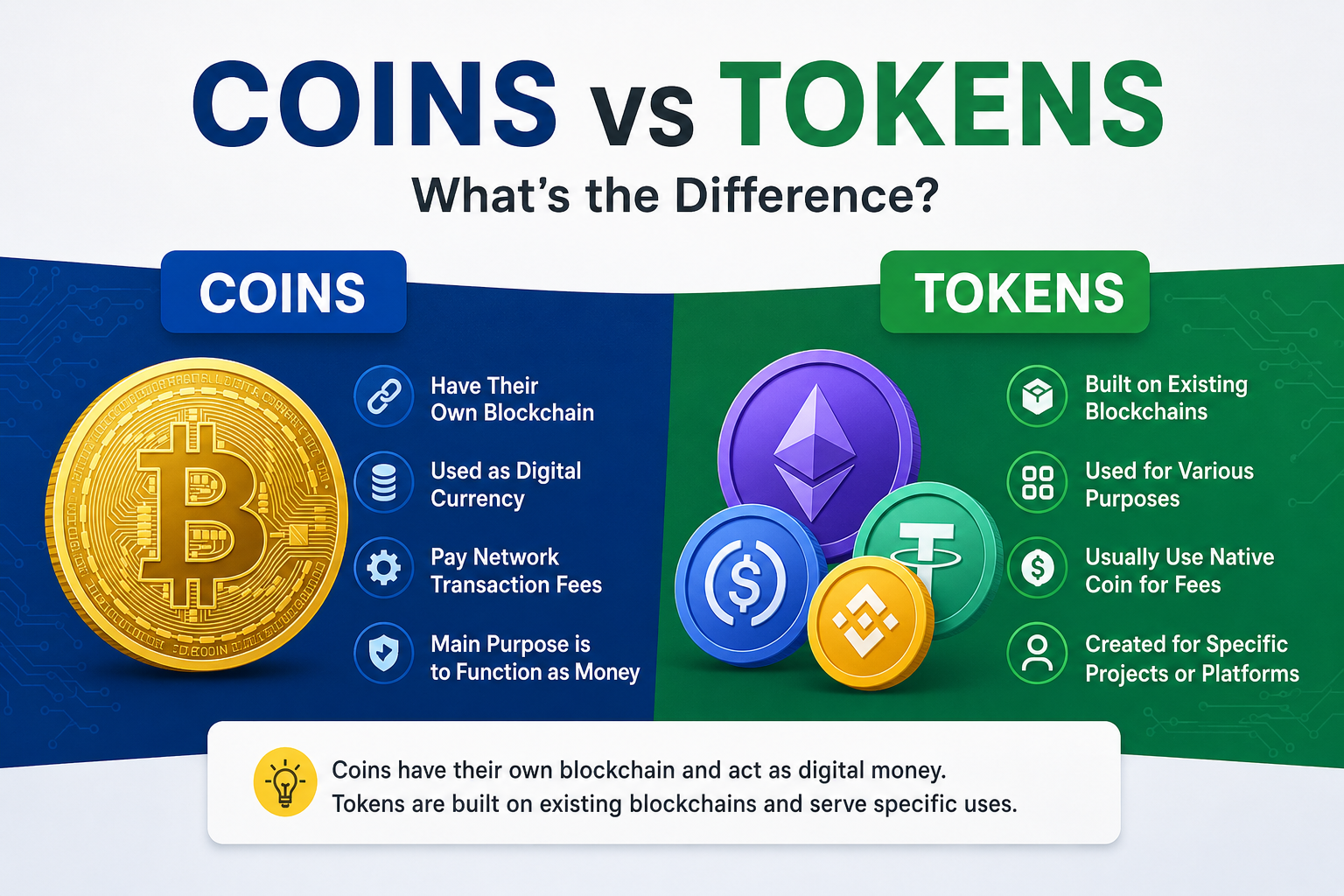
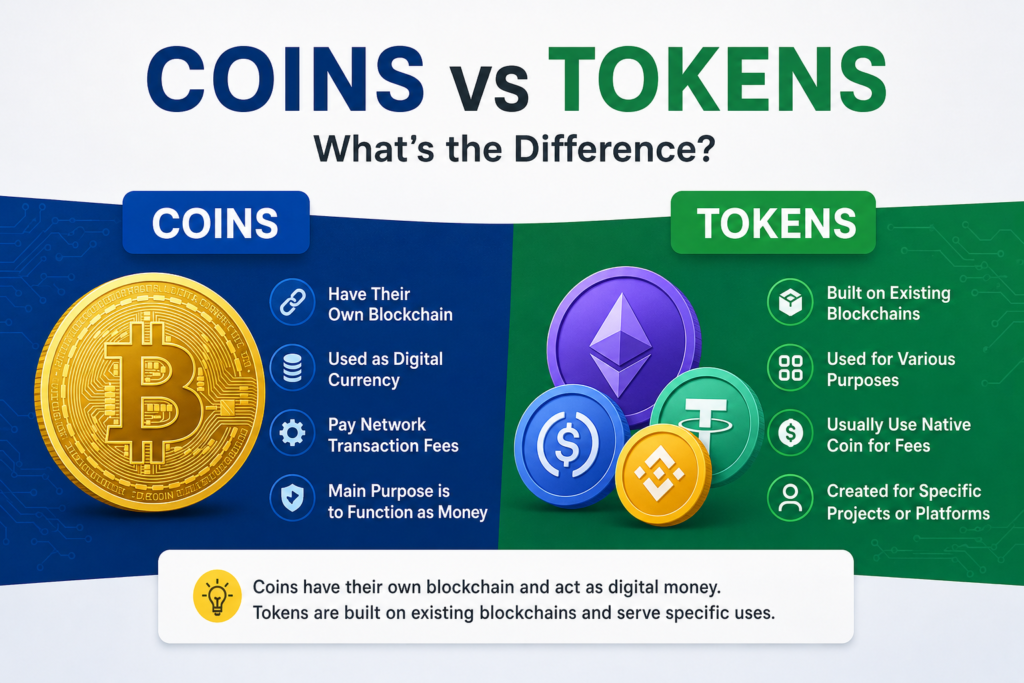
A coin has its own blockchain, while a token uses an existing blockchain.
A coin is often the native currency of a blockchain, while a token is usually created through a smart contract or similar system on another blockchain.
Coins are commonly used for payments, network fees, and blockchain operations. Tokens can be used for many purposes, including governance, rewards, applications, digital assets, and payments.
Creating a coin usually requires building or launching a blockchain. Creating a token can be easier because an existing blockchain can be used.
Final Thoughts
The difference between coins and tokens becomes much easier to understand once you focus on one simple question: Does the cryptocurrency have its own blockchain?
If the answer is yes, it is generally a coin. If it operates on an existing blockchain, it is generally a token.
From my point of view, coins are like the basic currencies that power their own blockchain networks, while tokens are more like digital assets that can be created for specific purposes using existing blockchain infrastructure.
I think understanding this difference is a good starting point for anyone learning about cryptocurrency. It helps make other topics such as wallets, transaction fees, smart contracts, decentralized applications, and blockchain networks much easier to understand.
Cryptocurrency can seem complicated in the beginning because there are so many new words and concepts. But once the basic ideas become clear, everything starts making more sense. For me, learning the difference between coins and tokens was one of those basic concepts that made the wider cryptocurrency world easier to understand.