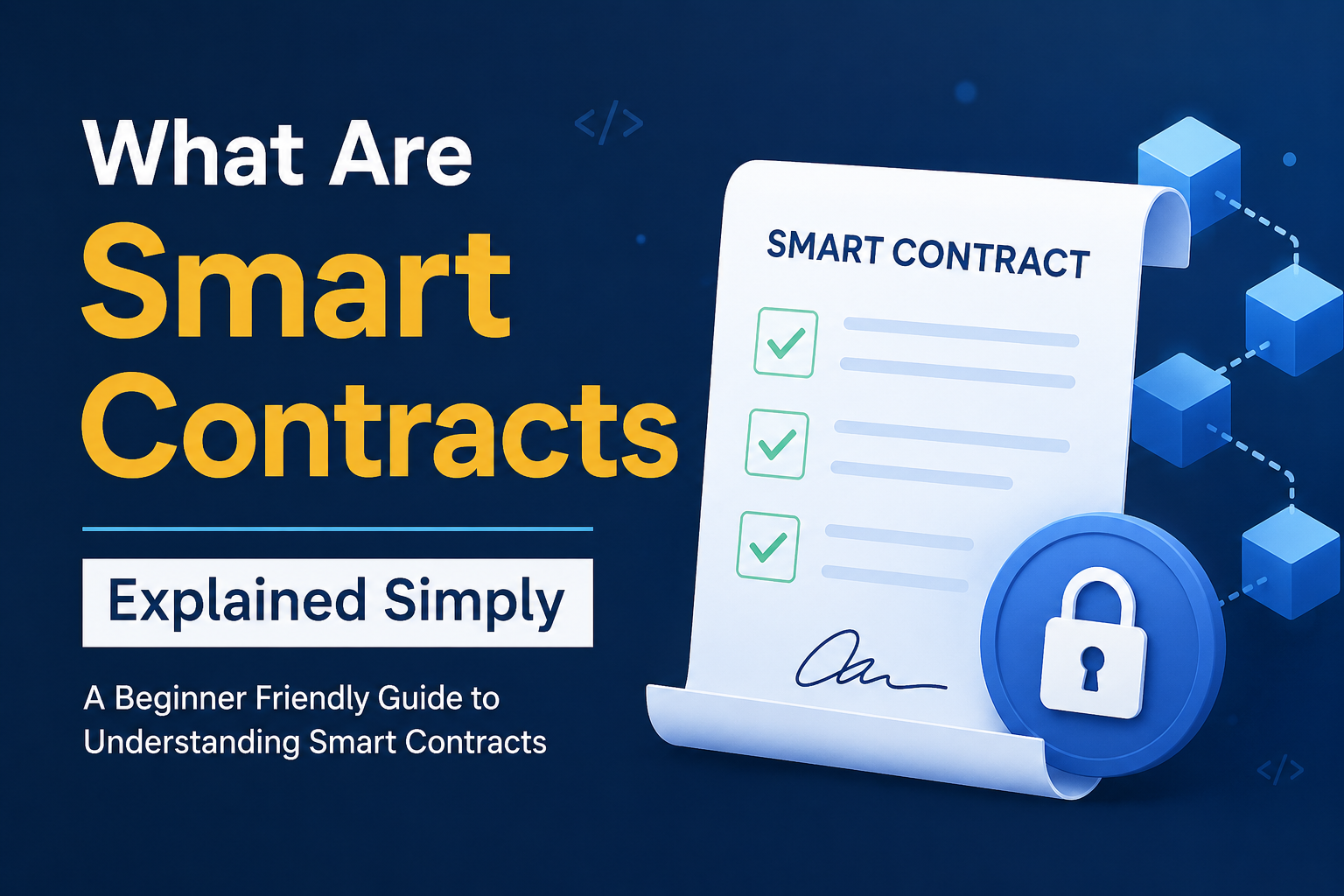
When I first heard the term smart contracts, I thought it was something very complicated that only programmers and blockchain experts could understand. The word itself sounds technical, but after learning how smart contracts actually work, I realized that the basic idea is quite simple. A smart contract is basically a program that automatically follows a set of rules when certain conditions are completed.
In my opinion, the easiest way to understand smart contracts is to think about a normal agreement between two people. For example, imagine that I want to buy something from you. I agree to send you money, and you agree to send me the product. In a traditional situation, we may need a bank, payment company, lawyer, or another trusted person to make sure both sides keep their promises.
A smart contract tries to make this process automatic. Instead of depending completely on a person or company, the agreement is written into computer code and stored on a blockchain. When the required conditions are met, the contract can automatically perform the agreed action.
What Exactly Is a Smart Contract?
A smart contract is a computer program that runs on a blockchain. It contains rules and instructions that tell the program what should happen in different situations.
For example, a very simple smart contract could say that if a person sends a certain amount of cryptocurrency, another person should receive a specific digital asset. Once the required conditions are met, the contract follows its instructions.
What I find interesting about smart contracts is that they do not need someone sitting behind a desk checking every transaction manually. The blockchain network verifies the transaction, and the smart contract executes the instructions according to its code.
The word contract can sometimes be confusing because a smart contract is not always a legal contract in the traditional sense. It is mainly computer code that is designed to perform an agreement automatically.
How Do Smart Contracts Work?
The process may sound complicated, but it becomes easier when we look at it step by step.
First, a developer writes the rules of the smart contract using a programming language. One popular language used for smart contracts on Ethereum is Solidity.
After the contract is created, it is deployed to a blockchain. Once it is deployed, users can interact with it by sending transactions or providing the information required by the contract.
The smart contract then checks whether the conditions written in its code have been satisfied. If the conditions are correct, the contract performs the required action.
For example, imagine a smart contract designed for a simple payment agreement. The rule could be that a buyer sends cryptocurrency to the contract and the seller receives the payment after the required condition is confirmed.
Everything happens according to the instructions written in the code.
This is one reason I think smart contracts are so interesting. They turn an agreement into an automated process.
A Simple Real Life Example
Let me explain smart contracts with an example that does not involve complicated blockchain terms.
Imagine that I want to rent a digital service from someone. Normally, I might send money to the service provider, and the provider would manually give me access. This process requires trust because I have to believe the provider will give me what I paid for.
Now imagine that the entire process is controlled by a smart contract.
I send the required cryptocurrency to the smart contract. The contract checks the payment. If the payment is correct, the contract automatically gives me access to the service.
There is no need for someone to manually confirm the payment.
Of course, real smart contracts can be much more complicated than this example. They can manage digital assets, decentralized applications, financial transactions, games, voting systems, and many other processes.
Why Are Smart Contracts Important?
In my view, one of the biggest advantages of smart contracts is automation.
Traditional agreements often require people or organizations to check information and complete different steps. This can take time and may also create additional costs.
Smart contracts can reduce some of this manual work because the code handles the process automatically.
Another important benefit is transparency. Since smart contracts operate on blockchain networks, their transactions can often be viewed and verified on the blockchain. This can make it easier for participants to understand what has happened.
Smart contracts can also reduce the need for intermediaries in certain situations. For example, instead of using a central company to manage a particular digital transaction, users may be able to interact directly with a smart contract.
However, I do not think smart contracts should be seen as a perfect replacement for every traditional agreement. They are useful for specific situations, but they also have limitations.
Smart Contracts and Blockchain
Smart contracts are closely connected to blockchain technology. A blockchain provides the environment where many smart contracts operate.
A blockchain is a distributed digital record that stores information across a network of computers. Because the information is verified by the network, users do not always need to depend on a single central authority.
Smart contracts use this technology to execute their instructions.
Ethereum is one of the best known blockchain platforms for smart contracts. It made the idea of programmable blockchain applications much more popular. Developers can create applications that run using smart contracts instead of relying entirely on traditional servers.
This opened the door to many blockchain based applications.
What Can Smart Contracts Be Used For?
Smart contracts have many possible uses.
One major area is decentralized finance. People can use smart contracts for activities such as lending, borrowing, trading, and managing digital assets.
Another area is digital ownership. Smart contracts can help manage digital tokens that represent ownership or access to something.
They are also used in blockchain games. In these games, smart contracts can control digital items, rewards, and transactions between players.
Another interesting use is crowdfunding. A smart contract can be designed to collect funds and follow predefined rules for distributing them.
Smart contracts can also be used for voting systems, insurance applications, supply chain management, and many other areas.
The important thing is that the possibilities depend heavily on how the contract is designed.
Are Smart Contracts Really Smart?
This is one question that I think many beginners ask.
Despite the name, a smart contract is not actually intelligent like a human being or an artificial intelligence system.
It does not understand situations in the same way a person does. It simply follows the instructions written in its code.
If the code says that a certain action should happen when a specific condition is met, the smart contract follows that rule.
This is actually both a strength and a weakness.
The strength is that the contract can be predictable and automatic. The weakness is that if the code contains a mistake, the contract may behave incorrectly.
This is why developers need to test smart contracts carefully before putting them on a blockchain.
Advantages of Smart Contracts
There are several reasons why people are interested in smart contracts.
The first advantage is automation. Once the required conditions are met, the contract can execute its instructions automatically.
The second advantage is transparency. Blockchain transactions can often be publicly verified, depending on the blockchain and application being used.
The third advantage is efficiency. Some processes can become faster because fewer manual steps are required.
Another advantage is that smart contracts can operate without needing one central organization to control every part of the process.
They can also make it possible to build applications that operate according to predefined rules rather than depending entirely on a central company.
For me, the most exciting part is the idea that software can handle agreements between people who may not know or trust each other personally.
Disadvantages and Risks
Smart contracts are not perfect.
One major risk is programming errors. A small mistake in the code can sometimes create serious problems. Since blockchain transactions may be difficult or impossible to reverse, fixing a mistake can be challenging.
Another issue is that smart contracts usually cannot understand real world information by themselves. If a contract needs information about weather, prices, sports results, or another outside event, it may need an oracle to provide that information.
There are also network fees. Depending on the blockchain, interacting with a smart contract can cost money.
Another problem is complexity. Even though the basic idea is simple, creating secure smart contracts requires technical knowledge.
This is why I believe beginners should understand both the benefits and risks before using applications based on smart contracts.
Smart Contracts in Everyday Life
We may eventually see smart contracts become more common in areas that people use every day.
For example, insurance payments could potentially be automated. If certain conditions are confirmed, a smart contract could process a payment according to predefined rules.
Digital memberships could also be managed through smart contracts. A person could receive access after completing a payment, and the contract could manage that access automatically.
Supply chains could use smart contracts to record different stages of a product journey. Payments could potentially be released when specific conditions are confirmed.
These examples show why smart contracts have attracted so much attention. They are not only about cryptocurrency. They are about using software to automate agreements and processes.
My Final Thoughts
In my opinion, smart contracts are one of the most interesting ideas that came from blockchain technology. The basic concept is actually easier than the name makes it sound.
A smart contract is simply a program stored on a blockchain that follows predefined rules and automatically performs actions when its conditions are satisfied.
The biggest idea behind smart contracts is reducing the need for manual intervention and creating systems where agreements can be executed automatically.
At the same time, I think it is important not to believe that smart contracts are perfect or completely risk free. They depend on the quality of their code, the blockchain they operate on, and sometimes outside information.
For someone who is just starting to learn about blockchain, I would say that understanding smart contracts is extremely useful. Once you understand the basic idea, many other blockchain concepts become easier to understand.
To me, the real potential of smart contracts is not simply sending cryptocurrency from one person to another. The bigger idea is creating digital systems where rules can be written into software and automatically followed.
That is what makes smart contracts so powerful, and I believe their role in blockchain technology will continue to grow as more people discover practical ways to use them.