When I first learned about blockchain, one of the concepts that caught my attention was Proof of Work. At first, the name sounded a little confusing because I thought it was simply about proving that someone had completed a certain task. But after understanding how blockchain actually works, I realized that Proof of Work is much more important than that. It is one of the main systems used to keep a blockchain secure, honest, and trustworthy.
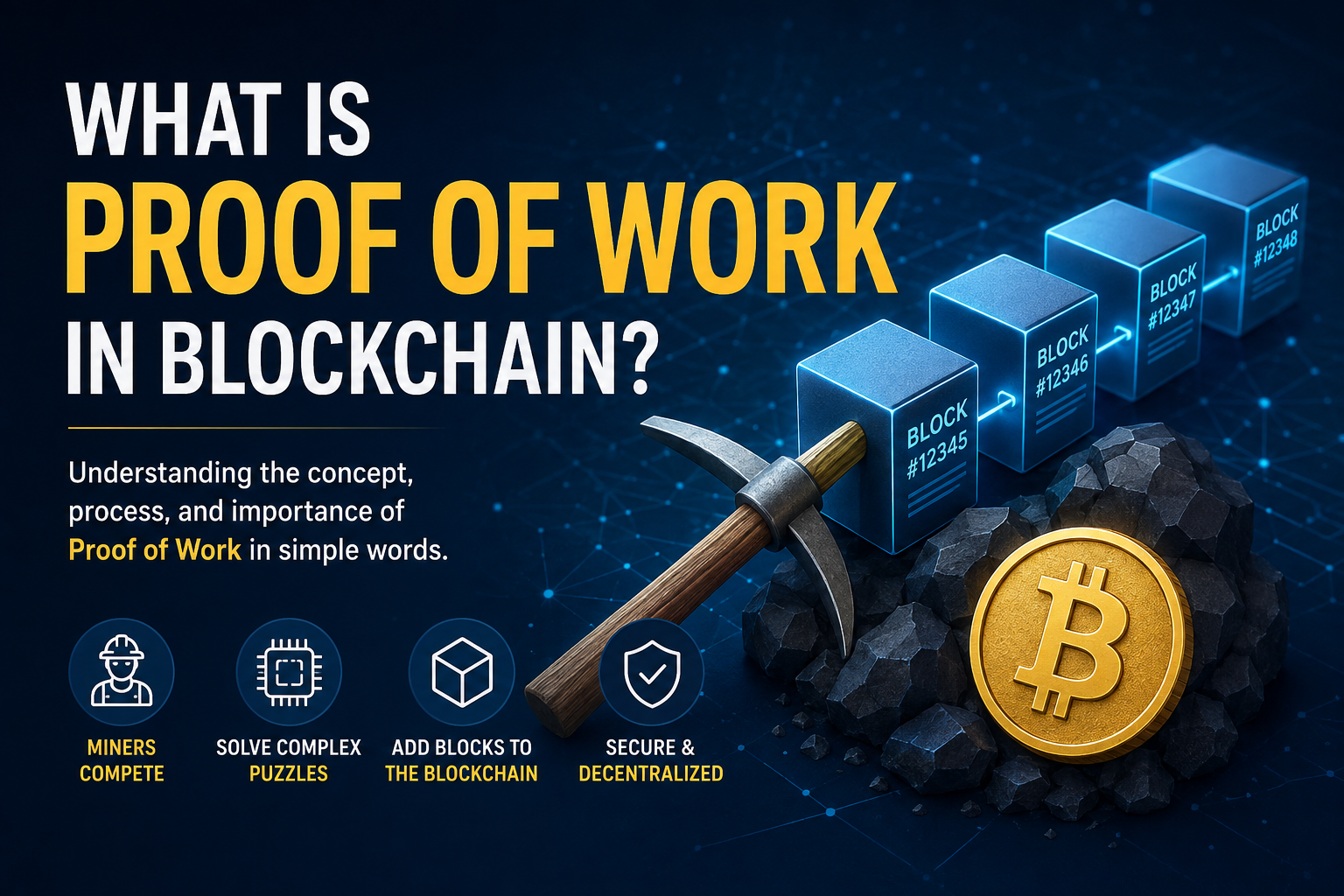
In my opinion, Proof of Work can be understood as a process where computers compete to solve a difficult mathematical problem. The computer that solves the problem first gets the opportunity to add a new block of transactions to the blockchain. This process requires computing power and electricity, which makes it difficult for someone to manipulate the network easily.
Proof of Work is most famously used by Bitcoin. When people talk about Bitcoin mining, they are usually talking about the Proof of Work process. Miners use powerful computers to compete with each other, and the winner receives a reward for helping maintain the network.
Understanding Proof of Work
To me, the easiest way to understand Proof of Work is to imagine a competition between thousands of computers. These computers are trying to find a special number that satisfies certain conditions. The problem is difficult to solve, but once someone finds the correct answer, other computers can quickly check whether the answer is correct.
This is an important part of the system. The network does not need to spend the same amount of time checking the answer as it takes to find it. Finding the answer requires a lot of trial and error, while verifying the answer is relatively simple.
This idea helps blockchain networks reach agreement without depending on one central authority. Instead of having one company, bank, or government decide which transactions are valid, the network participants follow a set of rules.
How Proof of Work Actually Works
When people make transactions on a blockchain, those transactions are collected together into a group called a block. Before this block can become a permanent part of the blockchain, miners compete to solve a mathematical challenge.
The challenge involves finding a value called a nonce. Miners repeatedly change this value and run the information through a cryptographic hash function. They continue trying different possibilities until they find a result that meets the network requirement.
There is no simple shortcut that guarantees the correct answer. This means miners may need to perform a huge number of calculations before finding the right result.
Once a miner finds a valid solution, it broadcasts the block to the network. Other participants check the solution and verify the transactions inside the block. If everything follows the rules, the block can be accepted and added to the blockchain.
I think this process is one of the most interesting parts of blockchain technology because it turns computing effort into a security mechanism.
Why Does Blockchain Need Proof of Work?
The main purpose of Proof of Work is security. A blockchain needs a reliable way to decide which transactions should be accepted and which version of the blockchain should be considered valid.
In a traditional banking system, a central institution manages the records. If I send money through a bank, the bank checks my account, confirms the transaction, and updates its records. Blockchain works differently because there may not be a single organization controlling the network.
Proof of Work helps solve this problem by making miners compete according to a common set of rules.
It also makes it expensive to attack the network. If someone wanted to change old transactions, they would need to redo the Proof of Work for that block and all the blocks that came after it. They would also need enough computing power to compete with the rest of the network.
This does not make an attack absolutely impossible, but it makes certain attacks extremely expensive and difficult.
The Role of Miners
Miners are an important part of a Proof of Work blockchain. In simple words, miners use computing power to process transactions and compete for the right to add new blocks.
A miner does not simply press a button and receive a reward. The computer has to perform a very large number of calculations. The miner that finds a valid solution first has a chance to add the next block.
For their work, miners can receive rewards according to the rules of the blockchain. In the case of Bitcoin, mining rewards have historically included newly issued bitcoins along with transaction fees.
From my point of view, this reward system is important because it gives miners a financial reason to keep supporting the network. They spend money on computers, electricity, cooling systems, and other equipment, so they need an incentive to continue participating.
What Is Hashing in Proof of Work?
Hashing is another concept that is closely connected with Proof of Work. A hash is a unique looking string of characters produced by a cryptographic hash function.
The interesting thing about hashing is that even a very small change in the original information can produce a completely different hash.
Miners use hashing again and again while trying different values. They are looking for a hash that satisfies the current difficulty requirement of the blockchain.
I find this concept useful because it explains why mining requires so much computing power. The miner cannot simply calculate one answer and finish. Instead, the computer has to try many different possibilities until it finds an acceptable result.
Blockchain Difficulty
Another important part of Proof of Work is difficulty. The network can adjust how difficult the mining challenge is so that blocks continue to be produced at a predictable rate.
As more powerful computers join the network, the overall mining power can increase. The difficulty can then be adjusted to maintain the desired block production time.
This is especially important for a large network like Bitcoin. Without difficulty adjustment, improvements in mining technology could cause blocks to be created much faster than intended.
In my opinion, difficulty adjustment shows how blockchain systems are designed to respond to changes in the network.
Why Proof of Work Is Considered Secure
One major strength of Proof of Work is that it makes dishonest behavior expensive.
Imagine someone tries to change a transaction from an old block. They cannot simply edit that transaction like changing a line in a normal database. Because each block is connected to the previous block, changing old information would affect the blockchain structure.
The attacker would need to perform the required computational work again and then keep up with the honest network.
This is one reason why Bitcoin has been able to operate without a central bank controlling every transaction. The security comes from a combination of cryptography, economic incentives, network participation, and computing power.
The Energy Problem
Although Proof of Work has important advantages, it also has a major criticism. The mining process can consume a large amount of electricity.
Mining companies often use specialized hardware that performs huge numbers of calculations. When many miners are competing at the same time, the total energy consumption can become significant.
This is something I believe should not be ignored when discussing Proof of Work. Blockchain technology offers interesting benefits, but every technology also has costs.
The environmental impact of mining depends on where the electricity comes from. If mining uses electricity generated mainly from fossil fuels, its environmental impact can be higher. If miners use renewable energy, the situation can be different.
Therefore, I think the discussion should focus not only on how much energy Proof of Work uses, but also on the source of that energy and how efficiently mining operations use it.
Proof of Work and Bitcoin
Bitcoin is the best known example of a blockchain using Proof of Work. When Bitcoin was created, the idea was to build a digital currency that could operate without depending on a central authority.
Proof of Work plays a major role in this design. It helps determine who gets to add the next block and provides an economic cost for attempting to manipulate the network.
For me, Bitcoin makes the concept of Proof of Work easier to understand because we can see the system operating on a global scale. Thousands of participants can interact with the network while following the same basic rules.
Proof of Work Compared With Other Methods
Proof of Work is not the only way a blockchain can reach agreement. Another popular method is Proof of Stake.
Proof of Stake works differently because it does not depend on miners competing through massive amounts of computation. Instead, participants usually lock up cryptocurrency as a form of economic commitment and are selected according to the rules of the network to help validate transactions.
I think both systems have their own advantages and disadvantages. Proof of Work has a long history of use and provides strong economic security, but it can consume significant energy. Proof of Stake can use much less electricity, but it introduces a different set of economic and technical considerations.
This shows that there is no single solution that is perfect for every blockchain.
My Final Thoughts
After understanding Proof of Work, I see it as more than just a mining process. It is a system designed to make blockchain networks difficult to manipulate. It uses computing power as a form of security and creates a competitive environment where participants follow the same rules.
The basic idea is actually quite simple. Miners compete to solve a difficult computational problem. The winner gets the opportunity to add a block to the blockchain. Other participants verify the result, and if everything is valid, the block becomes part of the growing chain.
What makes Proof of Work interesting to me is the way it combines technology and economics. Miners spend real resources to participate, while the network uses that effort to make attacks more expensive.
At the same time, I believe the energy consumption of Proof of Work is an issue that deserves serious attention. As blockchain technology continues to develop, people will keep looking for ways to improve efficiency while maintaining security.
Overall, Proof of Work is one of the fundamental ideas behind the original blockchain vision. It helped make decentralized digital currency possible and demonstrated that people can maintain a shared digital record without relying completely on one central organization. Even though newer blockchain systems are exploring different approaches, Proof of Work remains an important part of blockchain history and technology.