
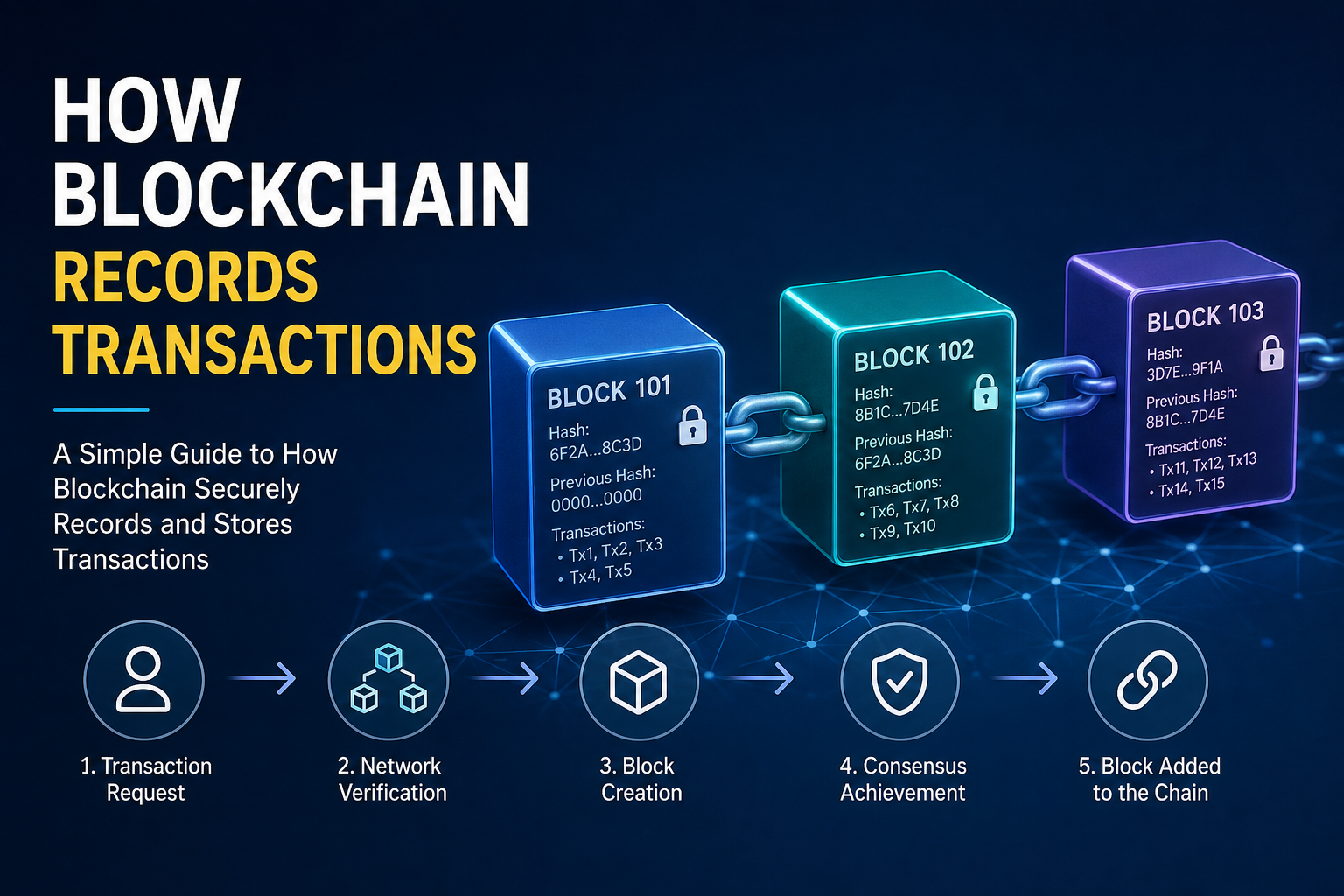
When I first started learning about blockchain, one of the things I found most interesting was the way it records transactions. At first, blockchain can sound like a complicated technology that only programmers or cryptocurrency experts can understand. But when I looked at it more closely, I realized that the basic idea is actually quite simple. Blockchain records transactions in a digital record that is shared across a network of computers. Instead of keeping the information in one central place, the system distributes it among many participants.
In my view, this is one of the main reasons blockchain technology has become so important. It changes the traditional way we think about keeping records. Normally, when we make a bank transaction, the bank keeps the official record. We trust the bank to store the information correctly and protect it. Blockchain takes a different approach. It allows a network of computers to maintain and verify the same record without depending completely on one central authority.
What Is a Blockchain Transaction?
A blockchain transaction is simply an action that needs to be recorded on the blockchain. The most common example is sending cryptocurrency from one digital wallet to another. However, transactions can represent many other types of information depending on the blockchain.
For example, a person may send digital money to another person. The transaction contains information about where the assets are coming from, where they are going, and how much is being transferred. The exact information depends on the blockchain being used.
From my point of view, it is helpful to think of a blockchain transaction as a digital instruction. Someone tells the network that they want to perform a particular action. The network then checks whether that action is valid. If everything is correct, the transaction can eventually become part of the permanent blockchain record.
The Transaction Starts With a Request
The process begins when someone creates a transaction. Suppose I want to send cryptocurrency to another person. I would use my digital wallet to enter the recipient’s wallet address and the amount I want to send.
My wallet does not simply send the transaction to one company for approval. Instead, it broadcasts the transaction to the blockchain network. Computers connected to that network receive the transaction and begin checking it.
This is an important part of blockchain because the transaction is not immediately considered final. The network first needs to determine whether the transaction follows the rules of the blockchain.
The wallet also uses cryptographic technology to prove that the transaction was authorized by the owner of the assets. This is usually done through a digital signature. The private key associated with the wallet is used to create the signature, while other participants can use the corresponding public information to verify it.
I think this is one of the smartest parts of blockchain technology because users can prove ownership without publicly revealing their private keys.
Transactions Are Checked by the Network
Once a transaction is broadcast, different computers on the network receive it. These computers are commonly called nodes. Their job is to follow the rules of the blockchain and help maintain the shared record.
The nodes check several things before accepting the transaction. They may verify whether the digital signature is valid and whether the sender has enough funds or assets available. They also check whether the transaction follows the specific rules of that blockchain.
If the transaction does not meet the requirements, the network will reject it. If it passes the necessary checks, it can move forward in the process.
This step is important because blockchain does not work simply by accepting everything users submit. There has to be a system that separates valid transactions from invalid ones.
Transactions Are Collected Into Blocks
After transactions have been verified, they are collected together into a group called a block. I like to think of a block as a page in a large digital record book. Instead of writing only one transaction on a page, the blockchain can group many transactions together.
The number of transactions that can fit into a block depends on the design of the particular blockchain. Different blockchain networks have different block sizes, structures, and processing methods.
When a block is created, it contains transaction data along with other important information. One important part is a reference to the previous block. This connection is what helps create the chain in blockchain.
The block also contains information that helps the network identify and verify its contents. This makes it difficult to secretly change old information without the network noticing.
The Role of Cryptography
Cryptography plays a major role in how blockchain records transactions. In simple terms, cryptography helps protect information and prove that it has not been changed improperly.
One important concept is the cryptographic hash. A hash can be thought of as a unique digital fingerprint generated from information. If the information changes, even slightly, the resulting hash will also change.
Blockchain uses hashes to connect blocks together. A block contains a reference to the previous block’s hash. This means that if someone tries to change information inside an old block, the hash would change. That change would affect the connection with the next block and create an inconsistency.
In my opinion, this is a major reason blockchain records are considered difficult to tamper with. The technology does not make changes mathematically impossible in every situation, but it makes unauthorized changes much more difficult because the network can detect inconsistencies.
How Blockchain Reaches Agreement
Another important part of recording transactions is consensus. A blockchain needs a method for participants to agree on which transactions should become part of the official record.
Different blockchains use different consensus mechanisms. Bitcoin, for example, uses Proof of Work. Other blockchains use different systems, including Proof of Stake.
The basic purpose is similar. The network needs a reliable way to decide which block should be added to the chain and in what order transactions should be recorded.
I find this part particularly interesting because there is no single central office deciding which transactions are correct. Instead, the participants follow a shared set of rules and use the blockchain’s consensus system to reach agreement.
Adding the Block to the Blockchain
Once a block has been accepted according to the blockchain’s rules, it is added to the existing chain. The new block becomes connected to the previous block.
Imagine a long chain made up of thousands or millions of connected pages. Each page refers back to the page before it. This structure makes the history easier to verify because every block is connected to what came before it.
As more blocks are added, the transaction becomes part of an increasingly long history. Depending on the blockchain, users may wait for additional blocks before considering a transaction highly confirmed.
This is why people sometimes talk about blockchain confirmations. A transaction that is included in one block has received a certain level of confirmation. As more blocks are added after it, the transaction gains additional confirmations.
Why Changing Old Transactions Is Difficult
One of the biggest advantages of blockchain is the difficulty of changing previously recorded transactions. Once information has been included in a block and that block has become part of the chain, changing it would require overcoming the cryptographic links and the network’s consensus rules.
If someone changes a transaction in an old block, the block’s hash would change. That would affect the connection to the following block. The person would then need to deal with the resulting changes across the chain while also competing with or overcoming the rest of the network, depending on the blockchain’s design.
This does not mean blockchain is completely immune to attacks. No technology should be described as absolutely impossible to attack. However, well designed blockchain networks make unauthorized changes extremely difficult and expensive.
The Record Is Shared Across the Network
Another feature I find important is that blockchain records are generally distributed across many computers. Instead of one computer holding the only official copy, many nodes maintain copies or relevant portions of the blockchain.
When new blocks are accepted, the network updates its records according to its rules. This distribution provides redundancy. If one computer stops working, the blockchain does not necessarily disappear because other participants can still have the data.
This is very different from a traditional centralized database where one organization may have primary control over the record.
Blockchain Creates a History of Transactions
Over time, the blockchain becomes a chronological history of recorded activity. Users can often examine transactions using blockchain explorers, depending on whether the blockchain is public and what information it exposes.
For public blockchains, this transparency can be useful. People can verify that transactions occurred without necessarily knowing the real world identity behind every wallet address.
I believe this creates an interesting balance between transparency and privacy. The transaction record can be visible, while the identity of the person behind an address may not be directly shown on the blockchain itself. However, blockchain should not automatically be considered completely anonymous because outside information can sometimes connect wallet addresses to real people or organizations.
My View of Blockchain Transaction Recording
From my perspective, the most impressive thing about blockchain is not simply that it records transactions. The more important idea is how several technologies work together to create a trustworthy record.
Digital signatures help prove that a transaction was authorized. Nodes check whether transactions follow the rules. Cryptographic hashes connect blocks together. Consensus mechanisms help participants agree on which records should be accepted. Distributed copies help keep the system running across a network.
When all these parts work together, the result is a record that can be verified by participants without depending entirely on a single central authority.
At the same time, I do not think blockchain is the perfect solution for every problem. It can have limitations involving speed, energy use, transaction costs, scalability, and privacy, depending on the specific blockchain. Some blockchain networks are designed for certain purposes and may not be suitable for others.
Conclusion
Blockchain records transactions through a process that combines digital signatures, network verification, blocks, cryptographic hashes, consensus mechanisms, and distributed storage. A transaction begins with a request from a user, is checked by network participants, and is then grouped with other valid transactions into a block. That block is connected to previous blocks and added to the blockchain after the network reaches the required agreement.
In my opinion, the real strength of blockchain comes from the way these different components work together. Instead of trusting only one organization to maintain a record, blockchain allows a network to collectively maintain and verify transaction history.
Understanding this process makes blockchain much less mysterious. It is not simply a digital database or a technology created only for cryptocurrency. At its core, it is a method of maintaining a shared digital record in a way that makes unauthorized changes difficult and allows participants to verify what has been recorded.
That is why I believe understanding how blockchain records transactions is essential for anyone who wants to understand the wider world of blockchain technology.